"[...] here in Cornwall, it is better, the wind blows very hard, the sea all comes up the cliffs in smoke. Here one is outside England, the England of London - thank God."
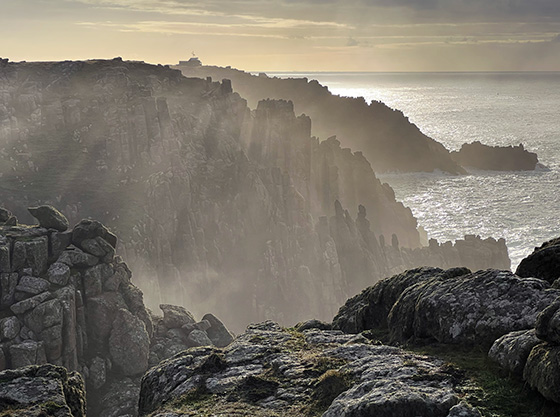
Carn Barra and Carn Guthensbrâs, West Penwith, 29th November 2022
(photograph by Adrian Bregazzi)
Sesselja Meyer had come to West Penwith from a "northerly elsewhere", from a place in a country that had become so risky that she often feared for her life. West Penwith seemed to offer her a new, safe somewhere, not only environmentally alluring, but a place that seemed pleasantly elsewhere from the the rest of England. She is settled now; and has come to know that "elsewhere from the rest of England" is a reality - the River Tamar border with England (Devon) is 130 kilometres away, a good two hours by car from West Penwith (a far longer drag in the summer). West Penwith is closer to Ireland and France than to London. Yes, of course, this same elsewhere attracts swaths of tourists in the summer months, but she has at least nine months which are far from the madding crowd, as she quotes, giving her unlimited time for reading, walking, making, and writing.
Making came slowly for her. The first pieces were small-scale, using very location-specific found materials. She told me that she was trying to get an understanding of the local environment, at the same time discovering the almost uncomplicated (she would hate "innocent") impulsive joy of just making small things, an experience that had been entirely missing from her own childhood. It all started by chance, she says. One day she noticed an odd terracotta-coloured stone at the foot of a wall next to a kissing gate on the coastal path. It was completely out of place in this granite heathland. For no real reason - she just did it - she picked up the stone and placed it on the wall. The next time that she passed through the gate, the stone had been moved to the opposite wall. She picked it up again and placed it back as close as she could to its original position by the wall. It was never moved again. She told me that it was several weeks later that she realised that this had not been just moving a stone, but a simple, performative act that in its own very small and very local way had changed the shape of the world, and that this had been the beginning of her creative work. This episode also prompted her thoughts about who may have moved the stone, and why did they move the stone just the once? Moreover, how did the stone come to be up there on the heath in the first place? Context, if you will.
The subsequent pieces she made were off-track, temporary assemblages that would soon disappear due to natural decomposition and the effects of abundant Atlantic weather. These had to be made at times when there would be least likelihood of people being around, lest they (and/or their dog/s) should find the sight of a person crouching in the heather, gorse, or wetland willows to be of interest or concern. This need for secrecy became essential to her future work.
The next phase in her work came as a direct consequence of her concerns about being seen making pieces; thoughts that sometimes actually got in the way of making the work. With careful pre-fabrication of materials already gathered from a chosen location, she started to make pieces so small that they could be left unnoticed in plain sight.
But much later, things all changed after she had embarked on very large-scale work. She was making a cartographic piece on the beach under the cliffs at Ped'n Vounder - it was to be seen from a single vantage point on the cliffs, marked in the making by a white post. She had finshed the work on the beach, and when she returned to the cliff-top, the post had been taken away. She tried in vain to locate its position. This event had a salutary effect on her way of thinking about her work, and she has since told me by way of explanation that she never repeats work.
In her own words: "several weeks after the theft, an exact photograph of the view of the work from the cliffs was shown online by a small, out-of-the-way gallery in London. I happened upon it purely by chance. When I eventually found and challenged the miscreant who had stolen the work - a self-styled performance artist she called a louse - he refused to admit the theft, actually threatening me should I persist in accusing him. He soon realised that this was a very painful error on his part, and he has probably been permanently stigmatised by the experience. But it was this resulting chain of events that caused me to make work that could not be stolen - work that was entirely hermetic - and all the more beautiful for it."
Sesselja Meyer may not be her real name, though she has firm views on the function of names. It is for the individual to decide how they carry their past through their life, and how they appear in the real and virtual worlds. This necessity for privacy is at odds with her love of telling stories; stories she may or may not try to publish one day, though under a nom de plume.
Sesselja Meyer is an avid subscriber to Virginia Woolf's dictum, "There is no gate, no lock, no bolt that you can set upon the freedom of my mind."
She has passionately maintained a very low presence online.