... in which US food historians tell us that genocide by starvation in Gaza has leant increased urgency to their discussing poor people's food
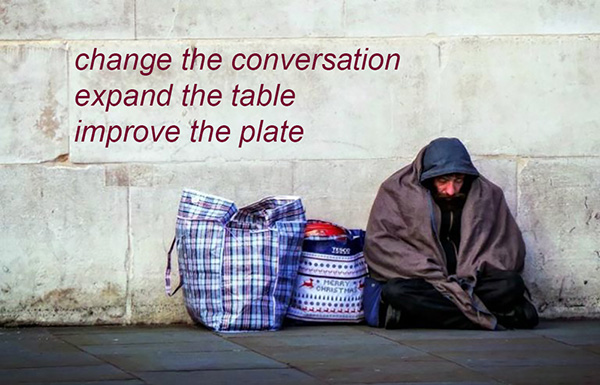 mash up of OSF&C mission with an image of Oxford street poverty:
Fair Use of image from Big Issue, St Mungo's, and Corpus Christi Church (Oxford)
In late September 2025, along with the above image, I posted a message on the facebook group page of the Oxford Symposium on Food & Cookery, relating to the 2026 symposium theme, Poverty Food:
Does it not seem iniquitous to have an intellectual gathering of participants travelling from across the world to a symposium costing hundreds of dollars, set in an elite academic environment, wining and dining while discussing the scant food of the poorest; worse still, stating that genocide by starvation in Gaza "has leant increased urgency to the theme of Poverty Food"?
It is rare for a post to elicit vigorous comments. However, one of the Symposium's US trustees commented with appeared to be a mild US expletive and a puerile cartoon image, refusing to explain either. Another long-standing US trustee ranted:
Adrian, So the other option is NOT to address serious issues? With your logic no one in a position of privilege should ever attempt to deal with difficult topics? Shame on your intellectual cowardice. [verbatim, accessed 14/03/2026]
Yes, I posted the mashed up Symposium mission with an image of Oxford street poverty not just to draw attention to the gaping mismatch between mission and homelessness, but also to draw attention to the main message of the post, that is is (at least) iniquitous to discuss genocide by starvation whilst wining and dining in a prestigious university refectory. I admit that "iniquitous" was soft-pedalling - "wholly immoral" is a better fit.
It seems that I was mistaken in even assuming that the symposium's 'poverty food' had something to do with actual poverty. A post on the group page by the Symposium chairman [sic], Cathy Kaufman, featured the following image and headline text:
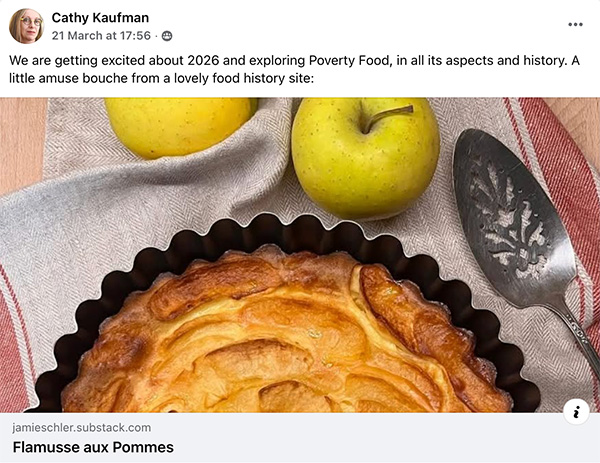 copy of a post on the OSF&C facebook group page, 21st March 2026
(Fair Use applied)
Clearly, rather than tackle the issues associated with real poverty, the Symposium is happy to promote playtime 'poverty food façon Marie Antoinette'. So much for dumpster-diving!
I have every admiration for the Symposium's history, and its long-standing aims and objectives. But it upsets me that it could be led into disrepute by those with a narrow-minded, ostensively polically motivated agenda.
Pushing aside the consequences of success, over the next few months I mulled over submitting a proposal to the Symposium that would go over similar ground in more detail, set in the context of state-initiated re-writing of history, and one that in effect would be a critique of the 2026 symposium itself. Not something that a symposium would normally reject, but a symposium in which there is such a loud US hegemony would reject without pause for academic or ethical consideration.
Thus, I didn't submit the following proposal (limited to 1000 words).
--- ---
The absence of reference to impoverishment in the USA in the theme descriptor for the OSFC 2026 symposium, Poverty Food (see)
It is the policy of my Administration to [...] remind Americans of our extraordinary heritage, consistent progress toward becoming a more perfect Union, and unmatched record of advancing liberty, prosperity, and human flourishing.
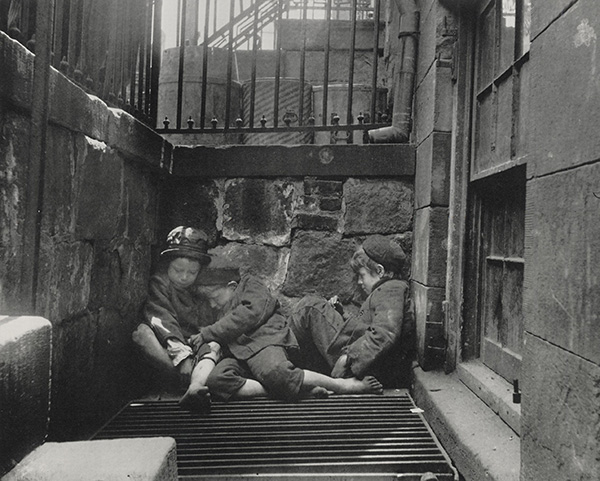 Street Arabs in the area of Mulberry Street, Five Points, New York City c.1890
Jacob Riis (1849-1914) Public Domain
This paper will explore significant historical instances of impoverishment in the USA, while considering their absence from the OSFC 2026 symposium theme descriptor, Poverty Food.
The United Nations has described poverty as, "a denial of choices and opportunities, a violation of human dignity. It means lack of basic capacity to participate effectively in society. It means not having enough to feed and clothe a family, not having a school or clinic to go to, not having the land on which to grow one's food or a job to earn one's living, not having access to credit. It means insecurity, powerlessness and exclusion of individuals, households and communities. It means susceptibility to violence, and it often implies living in marginal or fragile environments, without access to clean water or sanitation." (ECOSOC/5759)
However, from the outset, the symposium descriptor establishes a cozier, sanitized, elsewhere poverty as "the lack of resources necessary to thrive". Though "to thrive", to flourish, prosper, to grow vigorously, is not a metric of poverty, rather one of the denialist MAGA agenda. Moreover, it affords worthy discussions of poor people's food.
The text continues: "The recent rise of starvation as a weapon of war and oppression has lent increased urgency to the theme of Poverty Food" avoiding clearly stating, say, "Israel's tactical deployment of starvation in genocide, 'incidentally' clearing a way for a Trump Mediterranean Resort, is not about poverty: it's about starvation realizing a long, drawn-out, and barbaric death."
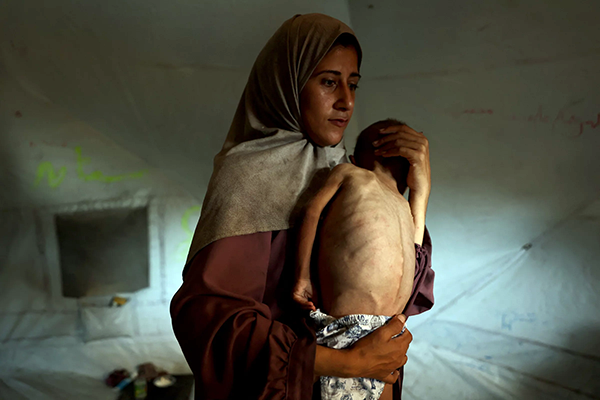 Hidaya, a 31-year-old Palestinian mother, carries her sick 18-month-old son, Mohammed
al-Mutawaq, who is showing signs of malnutrition, at Al-Shati refugee camp, west of Gaza City,
July 24, 2025.
© Omar al-Qattaa, AFP archives (Fair Use applied)
The symposium descriptor lists potential research areas:
- Rome, Cura Annonae (c.27 BCE to c.395 CE) [The Grain Dole]
- China, Great Leap Forward (1958-1962)
- England and Wales, Inclosure Acts (1604-1914)
- Universal, Tragedy of the Commons
- English, Externality
- English, Thomas Malthus [An Essay on the Principle of Population]
- Europe, Medieval ergotism [sic] rotting bread
- Ireland, An Gorta Mór (1845-1852) [the Great Hunger]
There are also references to quinoa (South America), la cucina povera, and incorrectly attributing Marinetti's call for the abolition of pasta to the Manifesto del Futurismo.
But there is no mention of:
- US Federal anti-poverty initiatives: The New Deal (1933-1935), The Four Freedoms (1941), The War on Poverty (1964-1965), The Great Society (1964-1968)
- Slavery (1776-1863/65); and subsequent Wage Slavery
- US Civil War (1861-1865)
- Great Depression (1929 -1939)
- Dustbowl (1934 -1940)
- Genocide of Native Americans (1492-1900?)
- Jim Crow (-1965)
- Inner-city deprivation (1964 -)
- Five Points slum, New York City (C19th and C20th)
I have made initial research into the list of potential areas that may relate to impoverishment in USA, initially:
Medieval Europe's ergotism [sic] rotting bread: Given the dominant vector for the ergot fungus is rye, that ergotism is poisoning produced by consumption of ergot, and that rye is primarily ingested in the form of rye bread, the inclusion of ergotism in the descriptor implies that rye bread is a signifier of poverty. Rye bread was a staple for most people in regions of Medieval Europe and Scandinavia where soils were unsuited to wheat, as such, it is an unreliable signifier of poverty. Nevertheless, looking away from Europe to early subsistence farming in North America, there remains an enthusiastically challenged theory that ergotism was instrumental in the behavior of accusers in the 1692 Salem Witch Trials. It is in the best interests of the Salem witchery industry that there should not be a simple, down-home explanation for the accusers' behavior, that rather than directed evil possession, loaves of moldy bread were the root of the problem. And the Salem Witch Museum Store "offers a wide assortment of items from educational materials to attractive apparel. With an extensive collection of books on the Salem witch trials and many locally made treats, we offer tried [sic], true and quirky products to appeal to young and old alike." 25 people were executed or died as a consequence of claimed devilry. However, all the so-called witches have since been exonerated, the last, Elizabeth Johnson Jr. was cleared in 2022. Witch hunt is a favored MAGA pejorative.
Though I wish to focus on instances of impoverishment in USA, for example:
US Anti-poverty initiatives (1964-1965): In his 1964 State of the Union address, Lyndon B Johnson stated, "Our aim is not only to relieve the symptom of poverty, but to cure it and, above all, to prevent it." The War on PovertyT was the adopted title of a raft of laws and initiatives intent on addressing a national poverty rate of 19%. The Food Stamps Act was created in 1964 aiming to help low-income people buy food. And further developments were made as part of Johnson's Great Society, including the Social Security Amendments of 1965 that created Medicare and Medicaid; the Civil Rights Acts of 1964 and 1965; the Voting Rights Act of 1965. The Great Society is an anathema for MAGA.
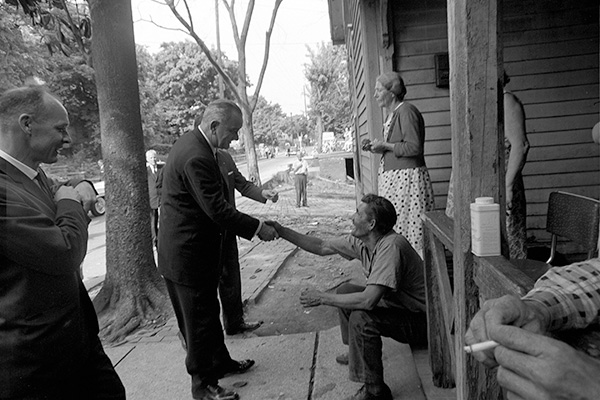 President Lyndon B Johnson shakes the hand of one of the residents of Appalachia VA,
7th May 1964
Lyndon B Johnson Library (Public Domain)
Johnson's visiting Appalachia is significant owing to the run-down, almost medieval ownership of land, industry, and (effectively) workers of the Appalachian region.
This paper will make an original and compelling contribution to Symposium discourse by interrogating the theme descriptor itself in the context of Executive Order 14253, and the MAGA agenda to rewrite history. Though this interrogation may preclude the proposal's acceptance.
-------------------------------------- --------------------------------------
The Oxford Symposium on Food & Cookery will take place at St Catherine's College Oxford, between 10th and 12th July 2026. (see)
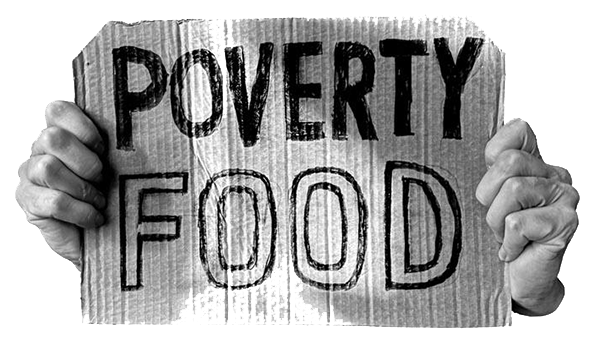 the official poster graphic for OSF&C 2026 Symposium, Poverty Food"
(Fair Use applied)
-------------------------------------- --------------------------------------
Further development of critical elements of the proposal, along with images and ideas not included in the symposium proposal, but would be included in the full paper/presentation:
The Ohio River Flood (January-February 1937)
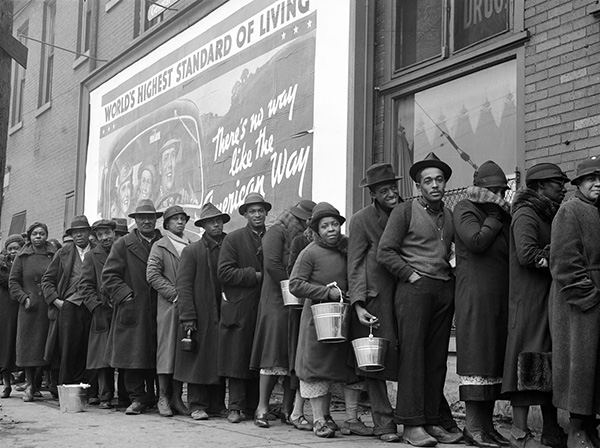 victims of the Ohio River flood queueing at a Red Cross Relief Station,
Louisville, KY. January-February? 1937.
Margaret Bourke-White (1904-1971). image is in the public domain
and the more famous version of this same scene
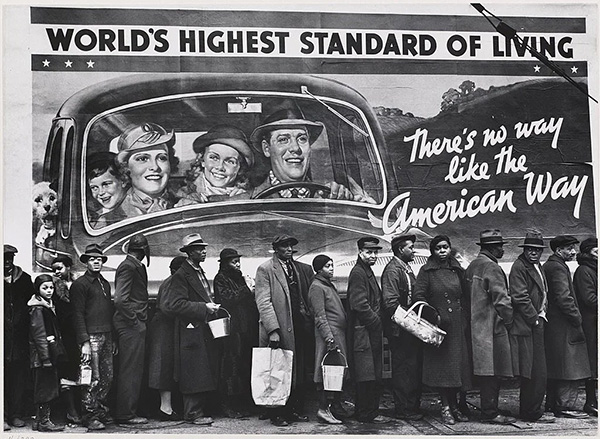 victims of the Ohio River flood queueing at a Red Cross Relief Station,
Louisville, KY. January-February? 1937.
Margaret Bourke-White (1904-1971). image is in the public domain
Both these images contrast the plight of (black) Ohio River Flood victims literally set against a NAM poster boasting, "there's no way like the American Way [if you're white]" Even the white family's dog has a better life. The National Association of Manufacturers (NAM) is committed to its ideals of free enterprise, competitiveness, individual liberty, and equal opportunity. And when these two phtographs were produced, during the Great Depression, NAM used one of the earliest versions of a public relations campaign, aiming to convince the American public and academia of the existential merits of an economic system free of governmental regulation and initiatives. Unsurprisingly, NAM opposed Roosevelt's New Deal.
There's an eerie familiarity here in the days of Project 25. And a familiarity that would not be welcomed by those food historians keen to protect the USA from its history.
The Dust Bowl (1934-1940)
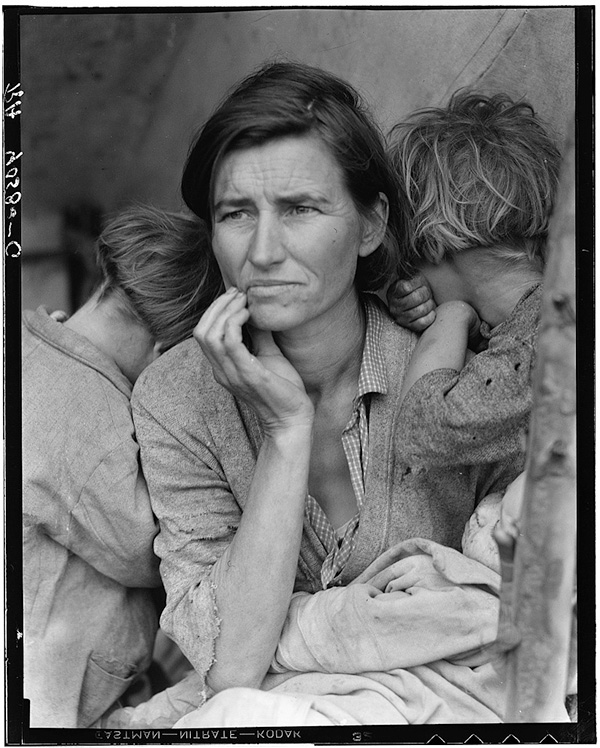 "Destitute pea pickers in California. Mother of seven children. Age thirty-two. Nipomo,
California." Florence Owens Thompson aka "Migrant Mother" with two of her children.
Dorothea Lange (1895-1965) for the Federal Resettlement Administration
US Library of Congress LC-DIG-fsa-8b29516 (digital file from original neg.)
image is in the public domain
Whether Florences Owens Thompson was a pea picker, and whether or not this photograph is posed, these are econonic migrants within the contiguous USA. But Dorothea Lange's last photograph of Florence Owens Thompson with some of her children is a grotesque poster image for the Dust Bowl, a largely man-made disaster that made over 500,000 people homeless in the 1930s. The 1936 negative was captioned, "Destitute pea pickers in California. Mother of seven children. Age thirty-two. Nipoma, California.", but it is better known by the sanitised "Migrant Mother". The Dust Bowl was a perfect storm created by C19th and early C20th US land policies, The Great Depression, bad agricultural practices, wind and drought. The worst affected areas in USA were in Colorado, Kansas, New Mexico, Oklahoma, and Texas. [image and text posted on the OSF&C facebook group page on 28th September 2025]
curriculum-inspired meals and weaponised starvation
The 2026 symposium blurb has gone through a number of changes since its first appearance on the Symposium website. One important element that contrasts poverty with the symposium's weekend activities has not been edited out, even though it lays bare a fundamental hypocrisy:
The Weekend promises distinguished keynote talks, paper panels in parallel sessions, curriculum-inspired meals prepared by guest chefs, and other educational and social activities.
Guest chefs producing meals inspired by poor people's food; social activities relating to poor people's food? Hearty food and fun & games, informed by weaponised starvation? A soup kitchen, Maria Antoinette style sanitised dumpster-diving, professor-led evening drinks while walking with Oxford's homeless alcoholics? A skills session on shoplifting?
But seriously, all this has been leant increased urgency due, inter alia, to genocide by starvation in Gaza, updated by Trump's war with Iran.
notes
Gaza: The Symposium skirts around the IDF invasion of Gaza with, "[...] the hunger that ravages war-torn areas even now." And there is no reference to genocide by starvation in Gaza in the symposium's theme descriptors, rather, this came from a personal email discussion I had with the Symposium's chairman [sic] in August 2025 that was subsequently shared by them with the Symposium's Board of Trustees. My referencing Gaza was never questioned in subsequent discussions.