This is the critical journal entry for the fourth topic of the first study block for the Fitzroy cohort in October 2022. The text is unchanged save for typos, accuracy, and anonymity.
Topic 4: Reading Photographs
I happened into an interesting discussion with one of the course tutors yesterday about "documentary photography" - specifically about the tags cited as the categories of documentary photography. One wonders how the following construction/collision would be so categorised.

screen grab of the Reading Photographs activity (task)
In the academic context of “reading a photograph”, this is a simple pedagogic provocation, establishing what is intended to engage the binary opposition of “ugly” and “beautiful”, or at least, the "disturbing" and the "alluring". On face value (literally assessing the appearances here of two young women), ignoring the respective back-stories (contexts) of the two images, and given that we are required to “read a photograph”, the problem here is language-based – to be solved in language. The solution is in the problem, but we should not forget that as in the following image, the problem is constructed.

(scissors/string) - the solution is in the problem
Binary oppositions – good/bad. true/false, light/dark – are hierarchical. The first element taking precedent over the second. This is the basis of our (western) value systems, and the basis of western philosophy.
Donna Haraway has argued, "certain dualisms have been persistent in Western traditions, they have been systemic to the logics and practices of domination of women, people of colour, nature, workers, animals - in short, domination of all constituted as others, whose task it is to mirror the self. Chief among these troubling dualisms are, self/other, mind/body, culture/nature, male/female, civilised/primitive, reality/appearance, whole/part, agent/resource, maker/made, active/passive, right/wrong, truth/illusion, total/partial, God/man. The self is the One who is not dominated, who knows that by the service of the other, the other is the one who holds the future, who knows that by the experience of domination, which gives the lie to the autonomy of the self." [Haraway, 1991, 177]

reversed hierarchical order of images,
screen grab of the Reading Photographs activity (task)
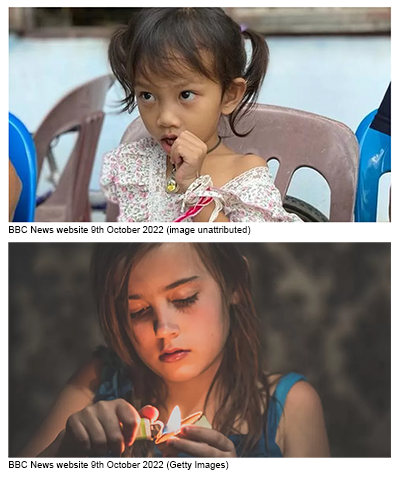
Reversing the order can alter our perception of the images, but the implied qualitative assessment remains - they have been placed together for a purpose.
If we do not know who this person is, her context, what can we "read" in this photograph of a young woman in the countryside?

Apologies for the mansplaining.
Reflection: Reading Photographs - Luc Delahaye, Taliban (2001)
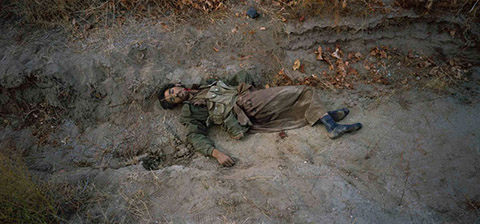
Luc Delahaye (2001)
We spent the best part of an hour discussing this photograph from 2001 by Luc Delahaye. What I have since discovered is that the image has a surprisingly low presence online. One hope that there is nothing sinsister behind this.

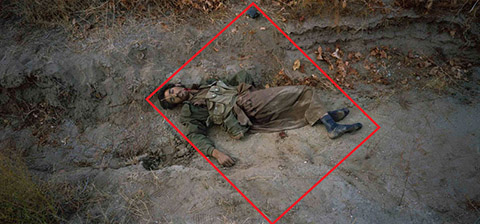
I cannot get away from seeing the Delahaye as re-constructed - posed in the manner of the deposition of Christ in this painting.
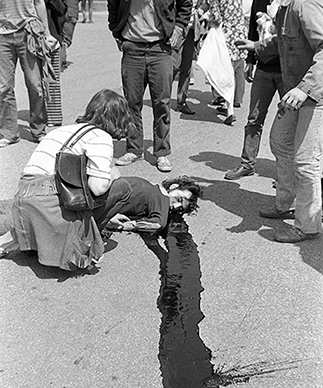
On the other hand, this too is an image of war. One of the most significant of the second half of the C20th. Unarmed Jeffrey Miller was shot in the mouth by Ohio National Guards on 4th May 1970 during anti-war demonstrations at Kent State University. Three other students were also killed that day. The then 14 year-old Mary Ann Vecchio is seen here begging for help as a torrent of blood poured from Miller's mouth.
The Washington Post magazine story included this rarely seen reverse view of the Mary Ann Vecchio photograph.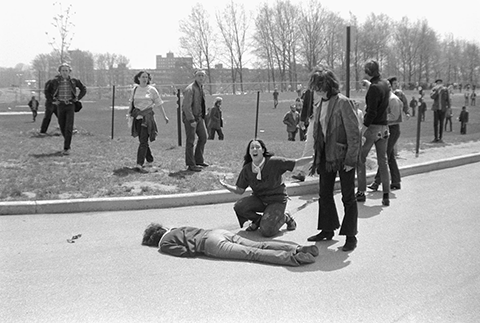
Reflection: Reading Photographs - Eliza and Florence Holder
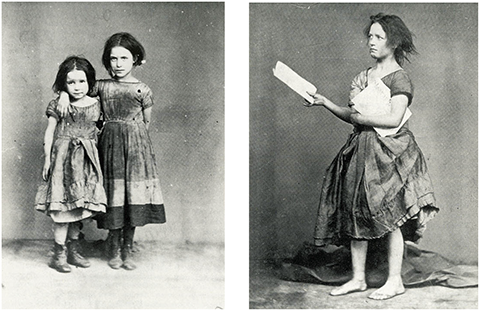
sisters Eliza and Florence Holder, from the Barnardo's archive
We spent the best part of an hour essentially playing old school Twenty Questions about these two images, which, I later found out, formed the core of an online article, Empathy, Charity, Emotional Narratives, and Cash, coincidentally written by the webinar tutor himself.


My drawing attention to comparing the Holder sisters' photograph with this "sweet nothings" voyeuristic photograph by Vanessa Winship in terms of archivist practice was ignored. This was a missed opportunity to discuss the broader implications of archivist practice.
There are five other essays in the same series by the same tutor - I wonder of any will form part of a future webinar? And it was only later that we were shown that this tutor may have a penchant for images of young girls in disarray in his own 'practice'.
And lest we forget another photographer of young girls ten years before the Barnardo's photographs of the Holder sisters: Kate and Elizabeth Keown, photographed by Julia Margaret Cameron.

Deconstruction continued: when deconstruction is not...

not the original Panzani advert referenced by Barthes,
but one equally replete with intention
Waitrose Food magazine, October 2022
"[...] About a decade later, Barthes wrote ‘The Rhetoric of the Image’ [1964] (in Image – Music – Text) in which he provides a highly detailed semiotic analysis of this advert [the Panzani pasta advert]. When it comes to examining how meaning is communicated visually, advertising images make excellent specimens because the investment in the minutiae of their design is remarkable compared to most other photographs: the resulting image, usually a photograph or a photorealistic digital composite combined with relevant straplines and branding are the result of numerous creatives and hours of work. We can be confident in the legitimacy of working backwards from these kinds of images, ‘deconstructing’ (idea coined by Jacques Derrida) [sic] the steps taken to build the visual narrative the consumer is meant to appreciate." [from the transcript of the Topic 4 presentation on Reading Photographs]
Here it would surely have been better to have continued to reference previously discussed semiotic analytical tools rather than misrepresent deconstruction as a tool for visual analysis and/or interpretation. We should remember that:
The "de" of deconstruction signifies not the demolition of what is constructing itself, but rather what remains to be thought beyond the constructionist or destructionist schema. [Gunkel, 2021, 3]
References
GUNKEL, David J. 2021. Deconstruction, , Boston MA: MIT Press.
HARAWAY, Donna J. Simians, Cyborgs, and Women, (1991), New York: Routledge.