As a young child I would often have been admonished with, "don't tell stories, Adrian!" With decades of hindsight, I think that this was, for those admonishing me, a more polite, better class version of "don't tell fibs!" And this itself was much better than, "don't tell lies!" (or Heaven forbid, broad Leicester's "you bleedin' liar"). Both telling lies, or telling fibs, was breaking the Ninth Commandment. Yet was telling stories actually such a big sin? And what about storybooks? What about Rupert Bear, Winnie-the-Pooh, Peter Pan, and the Little Prince? Were they bigger fibs, nice fibs even?
In the first instance, I can imagine myself thinking, quite literally, "but I'm not telling stories..." And now, looking back, I would like to think that then I'd be thinking something on the lines of, "my thoughts wander about a lot - I think I'm in lots of different places, not all at once, usually just one at a time, places I imagine I want to be in - isn't that like telling stories to myself?" Though I am certain that I would never have considered actually saying this out loud (nor even as a whisper), as the consequences would have been worrying.
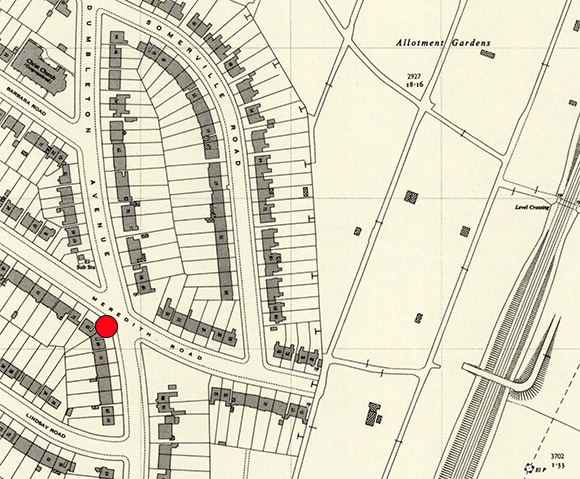 this is where I was when I saw the moon fill the sky...
Rowley Fields district, south-west Leicester
(see Google Street View view nowadays)
One day, I was walking home from school in good weather. I was six or seven years old (things were a lot different in those days). I'd got to the top of Dumbleton Avenue (see map detail), and something caught my eye. I looked down Meredith Road, over the allotments and over the then very much active Great Central Railway. I was drawn to the sky, which in this direction was entirely filled by the moon. I looked, stood still in my own place, for what must have been several minutes, unafraid, enthralled by the sight of the crater-filled sky, until I came to. I continued on my way home, just around the corner on Lindsay Road. I did not look back. I may have got a frown from my mother for being a few minutes late, but nothing more. I did not have to account for my tardiness, nor did I ever mention what I'd seen until now.
It was only some time afterwards that I realised that I could see no man in the moon in that close encounter.
I still tell stories; some written, some spoken; some online, some in personal notebooks. But not all stories are untrue...
Aunt Hilde: between waking and sleeping
I think that I was seven - that this was in the year my mother died. I was staying over at my grandmother’s house, as this may have been the time when she, my mother, was travelling to Lourdes to take the water, and to pray to St. Bernadette and the Blessed Virgin Mary to heal her of cancer. We were Catholics, my mother, my sister and I.
I had been told about the trip, that it was something called a 'pilgrimage', and that Lourdes was a place, not a group of important men. I had no comprehension of what was involved in getting from Leicester in the centre of England to Lourdes in the foothills of the French Pyrenees. We did have an atlas at home, and I was shown its location, "near some very big mountains", I was told. Though this did not help. I'd never seen a real mountain. And basically, I had no concept of long distance travel. I just knew that she was going away somewhere, but I was not told the real reason for the journey. I was probably being protected from what was happening.
[My mother's visit to Lourdes was made in the light of the Pope Pius XII encyclical, Le pèlerinage de Lourdes, issued in July 1957, to mark the centenary of the Marian apparitions in July 1858.]
I had been sent to bed at my normal time. However, it was a very warm summer's evening at my grandmother's and I was still awake, irritated. There was too much light, too much life pouring in through my windows from the park just over the road. I simply could not get to sleep while everyone else was out and about in the sunny evening. It must have been June too, as there was a blackbird still in full song.
 This is a photograph of my aunt Hilde, the Spiritualist. And guessing by the clothes, it
was probably taken in the late 20s maybe early 30s. Despite appearances, she is not the
young Professor Sprout.
Aunt Hilde was visiting my grandmother and had come upstairs to see why I was still awake. Her "auntness" was vague. She may have been part of my father's set. With hindsight I'm not sure what my mother would have thought of her beliefs and practices. She was not a Catholic.
After her "have you said your prayers" elicited a diversionary fib from me (I'd not been brought up to say prayers at bedtime, in fact I'm not sure that I ever knew which prayers were required). I clearly recall asking her, "why can't I remember falling asleep?"
"Because you haven't been to sleep yet."
"No, Aunt Hilde, not just tonight, why can I never remember falling asleep?"
"Well, it's because when you are asleep, you are asleep. And you can only remember some of your dreams from your sleep, and maybe then for only a short while after you have woken up as the dream flies away."
Aunt Hilde commanded both awe and fear in me – she was a Spiritualist. She spoke with the dead. I wondered if she spoke with Catholic dead, but I didn't enquire of her, as it seemed rude, and liable to cause problems. Yet my child-logic informed me that of all people, she must have an answer to this kind of question. Though I was unsure why I had come to this conclusion.
"No, (sheepishly) why can't I remember the last moment before I go to sleep? The moment in the middle of being awake and being asleep."
She frowned, then smiled. "It's not that simple. It's not like the difference between morning and afternoon - midday by the clock. No, it's more like the difference between daytime and night time - you can watch that happen, but it is impossible to say exactly when night time begins, even though it's just a matter of light and dark. And Ah! If you remember that moment you are trying to find between being awake and being asleep, you may never escape from it, and you may have passed through a gateway into another realm of sleep, so they say."
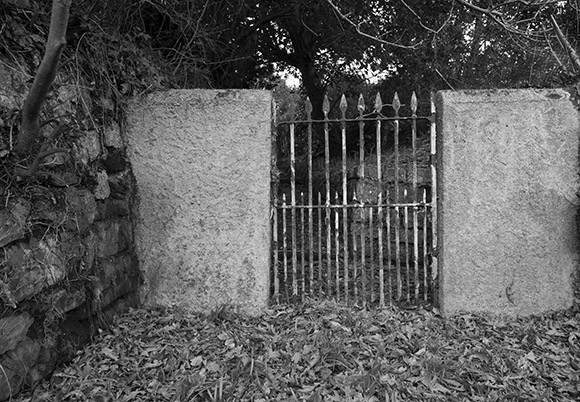 a little-used gateway nearby - it could be anywhere, anywhen...
I knew that she was trying to calm me with her common-sense logic, nearly as much as I was really annoyed by the things that 'they' do or 'they' say. Yet this simple statement shocked me to the quick. Why should remembering a single moment do this? How could this be? Wasn't it dangerous to leave moments like these lying around for children to find? But, how could I remember something if I never woke up, if the future was held back in the present, and the present was stuck somewhen?
"How, why?" I pursued.
"Well, maybe it's because you would be neither awake nor asleep. We should be one or the other - we can't be both at the same time can we? But being neither may be very serious, a long way away from the rest of us, maybe even in another world, another time, another us."
She was wise, but didn't really have a solution that I wanted to hear. And I was worried that 'another us' meant her spirit world, and the dead. I read myself to sleep with my pictorial comforter, de Saint-Exuperéy, maybe something like, though I cannot be so sure:
"[...] I gave up on my glorious career as an artist. Grown-ups never understand anything on
their own, and it's a nuisance for children to have to keep explaining things over and over
again."
(from The Little Prince, Antoine de Saint-Exuperéy, 1943: 2020 edition, page 2)
I do not believe that we ever spoke of it again, though I continued to try to map my nightly falling without any success. It was almost as if the soft seduction of falling proscribed its memory, that observation somehow interfered with the actual falling; that the falling somehow knew that it was being observed; that having passed through, the gate to consciousness was firmly closed behind you; and though you could still catch sight of all that lay there, it was impossible to recall any of those experiences. And, thankfully maybe, in the waking, this other realm would cast you back to your own world.
Perhaps I was also afraid of the consequences of success.
And now as a grown-up, I often wonder at our trusting our mind and body to wake us up each morning after we have willingly put ourselves to sleep the night before.
My mother's entreaties and prayers in Lourdes were unsuccssful in terms of curing, even halting the development of her cancer. And it's sad to think that she had had such a troubled life.
always wear clean underwear. . .
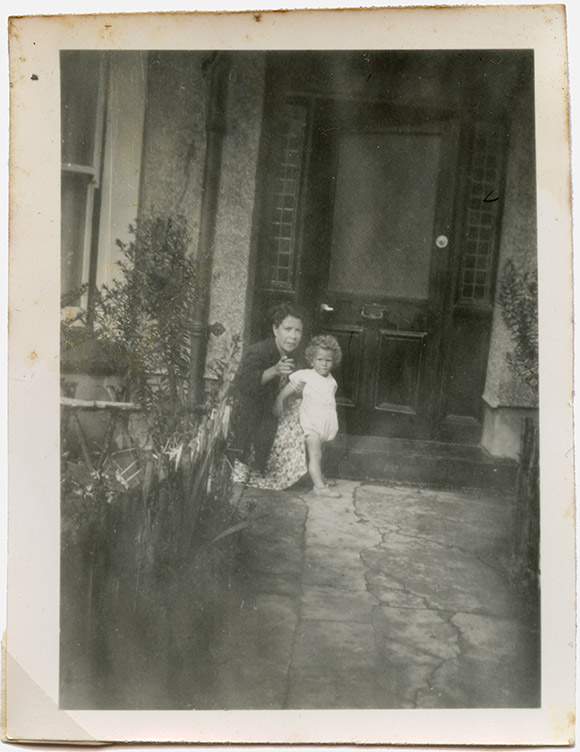 my mother and I, Clacton-on-Sea, summer 1952
a few years before the advice was given (at least before it would be understood)
This was the only piece of advice I can remember being given to me by my mother - though maybe it was more of an instruction rather than advice. That would make sense. I will leave it to you to imagine a context in which this instruction could have been delivered as it has little bearing on what follows.
So, one day, after the instruction had been repeated, I asked my mother, "why do I need to change into clean underwear every day?"
"In case you get run-over, and you have to be taken to hospital in an ambulance. The doctors and nurses won't think very much of a boy wearing dirty underwear, will they? Nor his parents!"
Imagining being run over, flattened, crushed by some unnamed vehicle - surely there would be lots of blood and other stuff messing up all one's clothes, not just underwear? Would it hurt - would I die? Would I go to Heaven?
But then I thought (very much to myself) "but I'm not going to get run-over. I have a guardian angel." One didn't answer back in those days. In any case, I had niggling doubts about guardian angels, and it really would have been a bad idea to have expressed those doubts.
Obviously, I cannot remember my stream-of-consciousness thinking about guardian angels that would occasionally come to the fore in my impressionable Catechismic mind, but I have a feeling that it may have oriented around amazement at how crowded the world must be if we all have an angel close to us, at least we Catholics; where do they go when we are rushing around in the playground, do they bump into each other like we do, do they fall over like we do; how do they fit in on a crowded bus; do they fly to keep up when we are riding our bikes fast; how do they manage without sleep; what do they like to eat; how big are they; do they have names; can they drive a car; do they get cold in winter; are they really just for we Catholics; does mine know that I am thinking this? I knew that I couldn't actually ask any of these questions as this would surely show lack of faith - and probably reap punishment.
Much much later, I was walking back home from town when I became aware of my whole body folding gently around the front of a moving 4x4. The next memory is lying on the road looking up as the 4x4 stopped just above my head. I'd missed most of the action - I'd been flung into the air, landing some 6 metres from the collision, at a roundabout at rush hour. My first response was to test moving feet and hands - was I paralysed? At-scene triage had a broken right leg, broken right arm, broken hip, and fractured skull - luckily, I had rag-dolled... But while they were cutting me out of clothes in the ambulance, I had the opportunity to thank my mother, as I was wearing clean underwear. And there was not much blood (and no 'mess') as technically I had been 'run into'. This accident happened over fity years after my mother's giving me the invaluable advice.
And my guardian angel had long-since given up on me. Or maybe I had given up on them.
postscript: I have a feeling that this recently discovered photograph may become my version of the 'little girl in the winter garden (le Jardin d'hiver)', only here, the 'little girl' is an adult, and I am the toddler. Roland Barthes wrote of the photograph of his mother as a little girl:
"[...] cartonnée, les coins mâchés, d’un sépia pâli, qui montrait à peine deux jeunes enfants
debout, formant groupe, au bout d’un petit pont de bois dans un Jardin d’Hiver au plafond
vitré."
("a cardboard photo, the corners chewed, of a pale sepia, which barely showed two young children
standing together, forming a group, at the end of a small wooden bridge in a Winter Garden with
a glass roof")
Eleanor of the dust
 'Eleanor at Loch Lomond, summer 1896',
Douglas MacEnnis, 1899.
Douglas MacEnnis is an almost forgotten Scottish pioneer of photography. The family wealth from trading with Norway and Sweden enabled him to devote considerable time and energy to creating the photographic image of Edinburgh that the city liked to promote – nothing but affluence and refinement.
The family's trading links had given MacEnnis a passionate interest in things Scandinavian (as had his father, who had given Douglas a middle name of Søren). But in 1896 his wife and daughter were tragically killed when masonry crashed through their brougham on the way to see Ibsen's 'The Wild Duck' – MacEnnis suffered head wounds which seem to have left him permanently brain-damaged. To friends he had become “depressed, introspective and highly imaginative”, but the trauma had left him time-locked in that summer of 1896. He was also seeing things invisible to others. He took to making photographs of subject matter that most would have considered worthless of attention as they were excluded from his hallucinatory vision. What appear as planar surfaces of rock, beach and ice to everyone else were seen by MacEnnis as portraits of a young woman called Eleanor. The most enigmatic of these images appears to be a perfectly exposed photogram of naturally distributed household dust. It is still unclear how this image was produced. The real identity of Eleanor also remains a mystery.
MacEnnis self-published “Eleanor, 29 portraits in the landscape” in Edinburgh in 1899, shortly before slicing his wrists with a photographic plate. The book actually contains 31 images. ‘Portraits’ that would have bewildered its contemporary audience as merely photographs of nothing, but which can now be seen as quietly exquisite examples of early abstract photography, wildly at odds with the conflicting photographic ideologies of the time. The images are all dated as MacEnnis' time-locked summer 1896. It is believed that only one copy of the book is extant (in a private collection in Argentina). Very few examples of Eleanor images are in circulation.
It is worrying to note that Dr Relling, one of the main characters in The Wild Duck, has the with-hindsight prescient line, "deprive the average human being of his life-lie, and you rob him of his happiness." Something cracked after publishing "Eleanor" - one wonders who deprived MacEnnis of his vision...
The image shown here is "Eleanor at Loch Lomond, summer 1896" from MacEnnis' book, "Eleanor, 29 portraits in the landscape". It appears to show fracturing sea-ice. As sea-ice is not common in Scotland, this photograph may have been taken on an unrecorded visit to Norway or Sweden.
Elvis's black soul
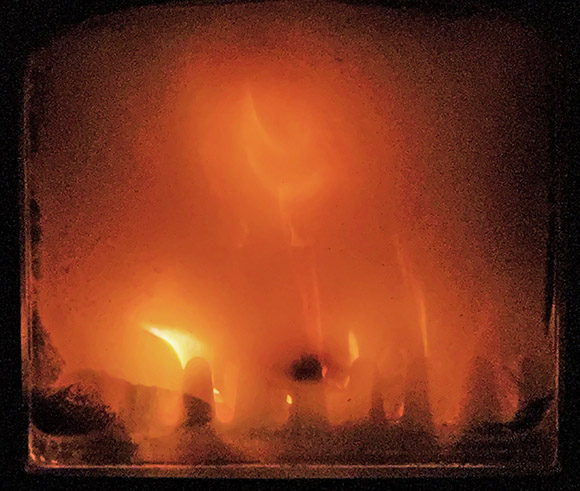 the homely living-room reminder of Hell's fire,
with a demonic construal
"God is an infinite sphere, whose centre is everywhere and whose circumference is nowhere”. In his essay posthumously published in 2019, Umberto Eco employs a two-dimensional version of this aphorism to explain how, in this case, we can clearly describe in words something that is both geometrically impossible and also wholly unimaginable - that “[…] there is a difference between being able to conceive of something or not, and being able to describe it and attribute some meaning to it.”
As a child brought up in Catholicism, and under the ruling guidance of priests, nuns, and the Catechism, I would not have had a problem coming to terms with this otherwise overwhelming description of God. It would not even have struck me as in any way odd, just another aspect of the tantalisingly near-palpable spirit world of a Catholic child, whose every living moment was monitored by a comforting, gowned and winged, but wholly invisible guardian angel just over his shoulder.
My guardian angel, my soul, the communion host becoming the body of Christ, the Holy Ghost, the Holy Trinity, were all as real, unquestionable, absolutely there, but just not visible. And there was the Immaculate Conception (whose significance was lost on children), the Nativity in a stable, the gruesome Crucifiction, and the otherworldliness and charisma of priests. Though I do remember having problems with my 'soul' - where was it, what was it? Assuming that I had been a good boy, did my soul, did I, or did both of us go to Heaven after death. Or did we have to wait for the Last Judgement?
These were austere pre-Vatican II times of the arcane but uplifting Latin Mass, when it was forbidden to attend any non-Catholic religious ceremonies, even school assembly (as when I progressed to a CofE grammar school in 1963), and when every Holy Day of Obligation and every day in Lent was a strictly observed meat-free fasting day. And fasting was also required before Holy Communion. Not that I ever wanted to be, I never felt good enough to be an altar boy, and it looked far too complicated, and a lot of lace.
I am sure that had I voiced it at the time I would have been painfully chastised, but this spirit world was just as real for me as my own world of make-believe, of play, of day dreaming, of fairy tales (if I was ever allowed them). And all this could easily be put into a day-to-day context as I have clear visual and auditory memories of being told in no uncertain terms that Elvis Presley had a black soul - black as in evil, dangerous, to be avoided at all costs, lest I be contaminated and be damned to Hell's fires as he was surely damned. His very inner being was corrupt. He was not a Catholic. I was frightened by this - coming from the thundering Ulster voice of our own family doctor.
Read what you will into this, but it took place while our seriously devout family doctor drove me and his son (soon to be an altar boy) and elder daughter to my first day at Catholic school in September 1957 The Catholic church in USA had become seriously upset by Presley in the spring of 1956, even complaining to the FBI that he was "a definite danger to the security of the United States," and his "actions and motions were such as to rouse the sexual passions of teenaged youth." But his first chart topping single in England was "All shook up" which peaked in July 1957. So, would it have been the Catholic Herald in 1956 or secular national news in 1957 that prompted the black soul outburst? Given that aside from this incident, I can only remember going to school with a friend, my being 6 rather than 5, seems more realistic, leaving the date as 1957. Assuming that I would start in this new school at the beginning of term, September fits best as it is also the beginning of a school year. (the only time I was ever driven to that school - from then on it was two bus journeys, crossing two main roads, plus not insignificant walking each way). I was a few weeks short of 7 years old.
I didn't think that my sister was an Elvis fan then, my parents certainly not. It was all very odd. I must have wondered how singing could be so bad?
With faith-lapse and hindsight one could say that I lived in an imaginary world, but as a young child of seven at the time of the Elvis incident I had no awareness nor concept of the imagination or the imaginary. All was real, just in different ways. How wonderful that would be today, or would it be?.
And Elvis surely made an impression on the devout.
sleeper
Once, it had been a damp 24C, the faintest glimmer of an analogue clock, all-but total darkness; it was easier to see with my eyes closed, though maybe to understand or remember rather than to see. All those hours of manual C41 and E6 deep-tank colour film processing lines. The smell of the chemistry.
Now cuddling, soft warm darkness, gentle undulating motion, a barely audible whoosh from the old school air-con. Womb-like? But dry - my sister died of an endometrial carcinoma. At right-angle to the direction of travel - unusual - overnight berth in cross-channel ferry; or a lucky four seats in cattle class, unlike the forwards/backwards flat beds up front and upstairs in long-haul travels.
It is not a fast train, easy on the minor irregularities in track that otherwise seem amplified while standing or sitting or typing. The train stops regularly, to catch its breath. But no announcements - I don't know where I am - and mostly no sound from others once they settle down. No phone chatter. Just the carriage creaks, the whoosh, and one's breathing and shuffling. Thinking back to the magical sound of a train being inside a building, in that train, in Paddington Station - hearing that enormous unbusied space at 5am.
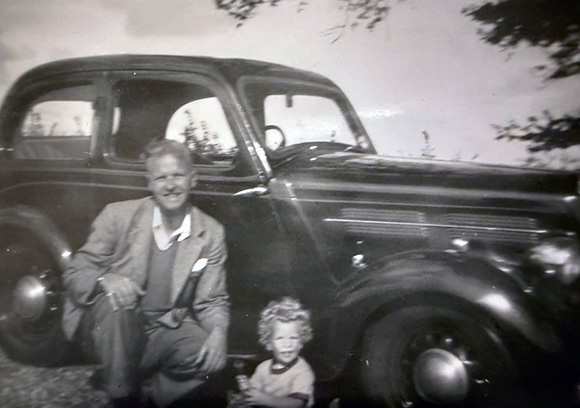 my father and I next to our old black Standard 8 car, summer 1952,
I assume that the photograph was taken by my mother; unknown location
note the rear-hinged doors, and semaphore indicators in the door pillars,
I wonder what I am playing with?
Where had these feelings come from? I scoured more, I could find nothing in my own experience, a lot was blocked I'd been told by my therapist. But four decades ago, my daughters in carry-cots on the back seat of our car, sideways on. Had my mother done this too? I have only a few clear memories of being in that car, black, with cracked and dessicated brown leather seats - they all were. I can imagine, create a pot pourri of old leather, cigarette ash, petrol and oil, the smell of tea from a flask (they were always cream coloured, with a thin red stripe), all that was car travel in the 50s. How was it that my mother was the driver, not my father, in those days of heavily gender-defined roles? More so, how is it that with all the lost memories of these times, I can remember the name of the man who mended the car when anything went wrong ("old Lol"), and that today I could take you to the exact spot where his garage was, in Leicester, just off the Narborough Road South...
We almost always lie in line with movement. So why is the sleeper as it is, as it does for me, to me. I am being cocooned in a warm, unthreatening, palpable darkness; a hinterland of reality; unphotographable - is this too fanciful? Like being dead and alive and neither dead nor alive - not waiting for the box to be opened to find out. Luxureating in an infrareal state - going off on one. Is this a low temperature version of Milton's 'darkness visible', surely not?
Should I read less?
Morphine - maybe that's what I'm remembering. Trauma Ward. Half my body in casts. Once I'd learned how to transform the epic snoring of others into a crackling log fire, or whatever worked at the time, I remember that same feeling of serene comfort, with the added benefit then of being able to create and enjoy my own animations, hallucinations as they are called by those outside, but real, actual for those of us inside. It is impossible not to see how this is addictive. The snake, hat, elephant mark on the wall; the sprites dancing on the privacy curtains; floating. And oh, the dreams - or were they dreams?
And how did it get here. Was I, am I asleep?
the transient
 a transient, but you may see this as a lemon...
This also all started in a novel. In a downward elevator, with a small sweet that tasted of peppermint:
""No, steel. Cold steel. The story unfolds in his head more than in his ears and there are words
but there aren't, pictures and sensations and tastes that change and progress from the original
mint and metal through blood and sugar and summer air. Then it's gone."
(Erin Morgenstern, The Starless Sea, 2019, p. 153)
This has been haunting me since first reading about it in 2019 - a sweet that tells a story, then it's gone. A multisensational dream? A structured hallucination? Imagine being able to script such tiny multilinear narrative spells to be experienced beyond mere spoken or written language - can there be stories inside the pre-mirror world? But inevitably here confined by written language. Maybe a simplified adaptation of the orchestral score in which staves address sensed elements rather than instruments, in tandem with directorial and contextual notation? How many simultaneous events can we sense? How/do/can we prioritise them?
And many years previously I had been drafting plans for software that could enable a computer to emulate dreaming (there was even support from a university for this, stymied by my not being an "academic"). And a recurring dream in which yellow repeatedly formed a link between one situation/incident and another incident/situation - yellowness, not the word, nor even "yellow" voiced, nor even the colour - an evanescent thing. But almost as I had written about this yellow in my notebook, it was gone. Never seen since.
I feel like I've been reading too much William Gibson before I go to sleep, but if that really were the case, I'd probably not be saying nor thinking that - it would be somewhere else, somewhen else. And I'm suddenly thinking that transients could become complusive, addictive, all-embracing visual opioids. This is all very odd.
But what is a transient?
Should I explain? Is it too good an idea to give away before I've even started with it? Or is it too mad ever to be happen? To be allowed?
Or does this come from the whisperings of the night sprites prone to wake one with, "did you know that C is pronounced in three different ways in 'Pacific Ocean'..." and its ilk?
shocked to the quick in a front room in New Delhi
She was planning a trip to a tiger reserve. This rather drew attention to herself. And she went on to explain that she was going to fit this trip into her work schedule.
I had seen her, maybe even noticed her, at work during the education fair earlier that day. I’d not seen her previously. And now, in the evening of that day, we were both in a group of maybe seven or eight international staff from UK universities, enjoying a social evening in our agents’ front room in a very quiet suburb of New Delhi (well, as quiet as New Delhi gets).
The conversation moved on to other guests, but I was intrigued as to how she was going to manage that trip at the same time as the daily demands of work. I couldn't see that there'd be sufficient time in our schedule to manage to do this. So after a while I asked her about this.
“Oh, it’s my birthday, and I wanted to treat myself while in India. And while in India, why not try to meet a tiger?” she said as if it were just like treating oneself to a nice evening out back home in England.
“Are you planning this trip on your actual birthday?” I asked.
“Yes, on Wednesday.”
“That’s my birthday too!”
She smiled, unsure of my motive maybe; and the whole group was now listening to our conversation.
“Is it a special birthday?” I asked.
“Not really, just getting older. I will be 55.”
This was quite a coincidence as I would be 55 on the same day. And after I explained this, and for no other reason than as she was working for a university based in Leicester, I asked her whether she was from Leicester, the place, not the university. To my astonishment she said that she was from Leicester.
“This is extraordinary.” I said. What are the chances of meeting somebody of the same age and with the same birthday, from the same city, thousands of miles from our birthplace.
There was now silence in the room.
“I was born in St Francis Nursing Home. London Road. Brought up a Catholic.” She said. But by now, I could barely speak, I was shaking, hit fair and square by the implications of what she’d just said.
“I was born at St Francis’ too, same day, same year…”
We stared at each other for a long time, until our host broke the electric silence enough for us to disengage for a moment. “How amazing, Helen and Adrian, meeting up and realising this in our front room!”
We continued our staring; and our respective private thoughts. Sadly, inevitably, we did not keep in touch.
noites em claro em São Paulo
This was my first visit to São Paulo, back in the late 90s. All my travel arrangements were organised by a college finance officer (let's call her Ethel), and all was based on making it cost as little as possible, irrespective of comfort, convenience, or safety. Said officer had no experience of long-haul travel for business, and it was just a spreadsheet project for her, though one generously spiced with jealousy. I should add here that in those days the finance department was exceptionally anal when it came to travel undertaken by non-senior management. I was grudgingly given a mobile phone, but firmly instructed not to tell anyone that I had a phone (!). I was not allowed cash advances nor a card, rather I was given a pile of $20USD traveller's cheques to sign. Even in the early days I was travelling for at least ten weeks per year.
My flight had arrived in the early morning, and Ethel was very pleased with herself as she had organised morning access to my room. However, this was not the case when I arrived at the hotel – I was made to wait for 3 hours before staff nervously led me to my dark pathetic room. During my sojourn in the hotel lobby I discovered that Lonely Planet described the surrounding area in terms of “somewhere you may wish to avoid”. Great choice on the part of my boss, who, anally retentive about most things, was particularly stupid when it came to getting what he considered “deals”, especially where my travel was concerned, and Ethel was more than happy to oblige in any way that she could.
As it looked as if my end was in sight and as I had this first day "free", I thought it best to do a daylight reccie of the area and almost immediately found a rather wonderful bar where I had a leisurely lunch (4 hours). After returning to the hotel for a snooze, during which I had the most disturbing dreams, I ventured back to the bar for the evening – to find that they were shooting a movie there and were more than happy to have rather eccentric foreigners in frame downing caipirinhas as if there was no tomorrow. It was a long evening, and I felt no threat walking back to my dreary hotel (possibly on account of the cachaça). Again, my night was filled with horrible dreams which were only made worse by the threatening ambiance of the room. The room felt deathly cold even with the air-con switched off. What a crap hotel I seemed to have while all my colleagues were enjoying the opulent (if somewhat unfinished) and better situated Renaissance Hotel.
When I checked out of the hotel, the staff were profusely apologetic for the delay in access to my room - apart from this, was the room comfortable, did you enjoy your stay at the hotel? Yes, all was fine, thank you - I wasn't confident in my ability to explain my difficulties sleeping, the odd dreams, and the odd atmosphere the room had had.
Ethel sought me out on my first day back in college. "How was the hotel in São Paulo?" "How was the room, did you sleep well?" She seemed unusually happy with herself, and she almost fell about laughing as she told me that the delay was caused by complications and procedures removing a body from the room. Both my boss and Ethel had also spread this about such that I was subject to, "did you sleep well in São Paulo?" or the highly amusing, "sleepless in São Paulo, Adrian?" for a few days after.
Karma: I filed a very polite complaint resulting in my being allowed to be the only person to organise all my travelling arrangements from then on, plus, more rational travelling expenses were offered. No doubt somebody also had a quiet word with Ethel, suggesting a less personal agenda.
Fact: I had a friend who was resident manager of a 450 room 4 star hotel in Hong Kong. I asked him about deaths in his hotel - he told me that with a greater than 90% occupancy rate, on average there were less than two deaths in two years (but that the next time I used a lift, I should note that it is large enough to take a coffin). So, on that basis, I began to think that I was clear of recent death beds for quite a while, though one should never dwell on what might once have been happening in the room you are now occupying, and where you will hopefully find untroubled sleep.
postscript: A year or so later, having completed a very long business trip, Ethel excelled herself by refusing to pay a daily expenses allowance as one of the days on the trip did not exist as I had crossed the International Date Line when travelling from Los Angeles to Tokyo. Finance supported Ethel's assessment, only to be embarrassed when on a subsequent trip I crossed the Date Line in the opposite direction, claiming an "extra day."
a dust sprite
My grandmother’s house had areas that one didn’t see. They weren’t specifically out of bounds, you just didn’t go there (tins, drawers, an ottoman, cupboards, shelves, rooms even).
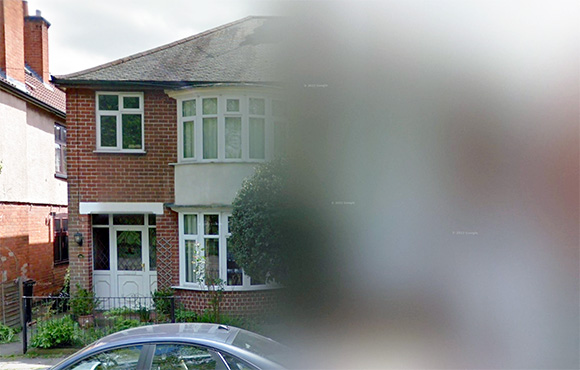 my grandmother's house in 2016, 44 years after she died
(image taken from Google Street View)
It is odd to see that tall white rose bush in front of the bay widnow. It is named Frau Karl Druschki, first bred in Germany in 1901. Given that the house was built in the inter-war years, and that it is unlikely that a German rose would have been planted after 1933, it is astonishing that it still survives to the date of this image - it could be well over 80 year's old.
The small front bedroom was home to an evil spirit that dwelled in the dust on top of the wardrobe – sleeping by day, but chattering, scraping, whispering and puthering by night. I spent just one terrifying evening there until darkness finally drove me out, and having to threaten to sleep under the huge cast-iron clothes mangle in the garden shed allowed me to be ushered into the sanctuary of the ‘guest bedroom’.
From then on, whenever I could (not often, as this room became one of the places one did not visit), I sought to terrorise the spirit by sneaking into its room in daylight hours and beating hard on the wardrobe, threatening with a duster and shouting at the top of my voice. My grandmother could never understand this behaviour and held lingering doubts about my sanity right up until she left this world – “this house is not haunted!” While the spirit did its best (but generally failed) to be heard through the bedroom wall whenever I slept in the guest room, for luckily it was sedentary – itself imprisoned on an inhospitable dusty plane in an abandoned room.
I wonder if it's responsible for blurring the Street View?
In the back garden a sycamore corner lay below the gable-end of back neighbour’s outbuildings. It was guarded at ground level by a perimeter of cat-shit – the cats ventured no further than this communal warning. The curiously shaped gable hummed and whined even when there was no wind. This was not a threatening spirit as such, it lived over the fence and was just a back garden annoyance that was best ignored.
There was also an almost life-size Venus who peered over the fence from the garden of the adjoining house, and which, to my young eyes, looked as if it were waiting to be moved to a cemetery to join its elderly owner when she eventually left home for good.
the new wave
One day, the college thought it would be good to have a regular newsletter, to keep staff informed on important developments. This fell to me, not just to glean relevant information, but to write copy, procure images, design, type/set and proof the newsletter - and eventually a lot more.
The college was in the early stages of planning a new student hall of residence, but it was trying to keep the proposed site a secret until the last moment. With an aerial photograph of the town taken a year or so earlier, I wrote a short piece, "Spot the Hall", for the first edition of "new wave". The principal's PA called me before publication, pointing out with much glee that the site was not in the photograph - not only rather giving the game away, but also saving my having to award a prize for the best X.
And when local television contacted the college for an interview about the development, I was sent home to change into somethimg more appropriate for a recorded interview. I never saw the recording when it was broadcast, but it was undertaken in good humour as I knew the interviewer (she was a college graduate), and I had explained the circumstances. I was later given media training.
It didn't take too long for me to realise the potential power behind authoring text in an offical publication, one that went to all staff. Outside senior management, my boss at the time was seen as a person with whom one should tread very carefully. His favourite saying was, "trust me", seen by many as best advice not to do anything of the sort. I put together a story that recounted the discovery of tesserae from a Roman mosaic when the hall of residence site was being excavated. I added a Dog Latin version of my boss's family name as the name of the most notorious Roman known to have lived in the area, who had the motto, "crede mihi" (but did not provide a translation). There was little response from the article at the time, with disappointingly nobody translating "crede mihi" ("trust me").
I moved on with articles such as announcing that the college had been chosen to pilot a cutting edge staff development/training system based on physical digital implants surgically inserted into necks of staff for directly delivering training. I got just a handful of calls about this, but at the same time I got a call from a somewhat irate official archaeologist group demanding to know why they had not been called in to supervise examination of the tesserae found at the hall of residence site, and that further digging may be required...
As it was often said, "semper ubi purus sub ubi!"