A holding page for recent and developing writing in progress while I ponder how to "classify" them page-wise online. They are mainly aiming to create a past from volatile shards of memory - enadeavouring to bring some form to the currently formless.
All our yesterdays
And all our yesterdays have lighted fools
The way to dusty death
It is difficult for me exactly to date events concerning both myself and my parents up to February 1964. For example, we had a television at home, and I can remember programmes that could provide an indication when we first had a television, but I may have seen these progammes at another house, and therefore the memory does not specifically confirm a television at home. Likewise, I can remember important events without the need to check out history today, and feel more confident that I am remembering them occuring, not just from later documentaries (but I did have to confirm most of the month dates). I have a cluster of such certainties: U-2 Incident 1960 (May); Yuri Gagarin 1961 (April); Telstar (July 1962); Cuban Missile Crisis 1962 (October); Profumo Affair 1963 (June); John F Kennedy Assassination (November 1963). And the epic winter of 1962-63 (when I started secondary school and the outside toilets froze).
contemporary newsreel footage was used extensively in All our yesterdays
However, I do have clear memories of Brian Inglis's weekly programme, All Our Yesterdays, which reviewed events leading up to and during the Second World War through the newsreel shown in cinemas 25 years previously. The series started in 1960, but I have no confidence in saying when I first saw any of the programmes from those early days. I have two firm memories from progammes: "phoney war", and Auchinleck. Both words seemed odd at the time: phoney was too casual, too American sounding; while Auchinleck just sounded silly (and I had no idea how to spell the name). The Phoney War covered the period from September 1939 to May 1940, when little seemed to be happening in terms of hostilities for most people in UK, though this was the time for mass evacuation of children from London. Most references to Auchinleck would have been during his role in North Africa (July 1941 to August 1942). Events from 1939 to 1942 would be covered in programmes from 1964 to 1967, well after the series start in 1960.
I have less confidence in my remembering something to do with the Hungarian Revolution (October to November 1956); the Suez Crisis (October to November 1956), Elvis being shipped off to Germany (October 1958 to March 1960), Kennedy becoming US President (January 1961), or the building of the Berlin Wall (August 1961). Just the odd word or picture for these events.
All Our Yesterdays was broadcast on ITV at a peak viewing time of 7pm on a Monday, immediately before Coronation Street (I think), with advertisements. There was an element of class at issue here - BBC was proper (Dixon of Dock Green) and no adverts, ITV was common (Coronation Street) with adverts. And your viewing ITV would itself be openly advertised by the style of the receiving aerial high on your chimney. Mainstream BBC had always been received using an H shaped aerial; ITV required an X shape. Having said that, All Our Yesterdays did provide a running historical context for the remarakably unstable Cold War times, but with hindsight I wonder how much of the context was noted then.
Confirming that not all was lo-brow or common at ITV, the title "All our yesterdays" was taken from Macbeth's short soliloquy on hearing of the death of Lady Macbeth:
She should have died hereafter.
There would have been a time for such a word.
Tomorrow, and tomorrow, and tomorrow
Creeps in this petty pace from day to day
To the last syllable of recorded time,
And all our yesterdays have lighted fools
The way to dusty death. Out, out, brief candle!
Life's but a walking shadow, a poor player
That struts and frets his hour upon the stage
And then is heard no more. It is a tale
Told by an idiot, full of sound and fury,
Signifying nothing.
PLUTO
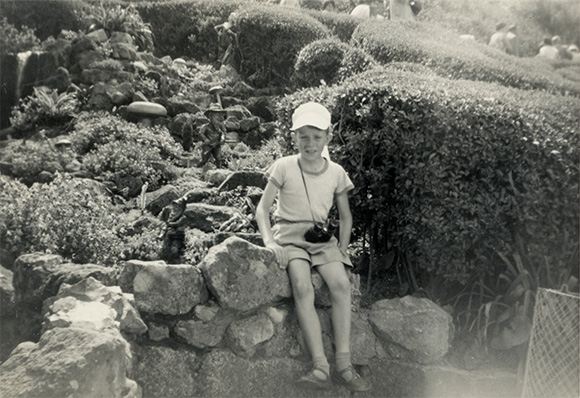 Shanklin Chine, June 1960; I seem unhappy...
I first encountered PLUTO while on holiday on the Isle of Wight one June in the late 1950s/early 1960s. We always holidayed in June, something to do with my father's work, or maybe just because it was cheaper and less crowded than July or August. It was a dull metal pipe running in the direction of the sea from a place oddly called Shanklin Chine. It's now painted teal, with bright lettering thus: P.L.U.T.O.
"What is this?" I asked my father, as for me Pluto was a silly cartoon dog. He explained, "PLUTO is short for Pipeline Under The Ocean", and it was used to pump petrol from here to France in the last war. He would have used capital letters for Last War, but this was not possible in speech alone, and, as was his wont, he didn't talk much about the war. I don't think many people did, at least, not in front of me. Just some fifteen or so years had passed since the conflict had ceased - it was still very much stuck at the back of the minds of those who'd lived through it, but people now had another war to worry about, a Cold War.
But I was still young enough to ask difficult questions about how things worked, other things too. And looking at this heavy length of metal pipe, then looking out to sea, all the way to the horizon, from behind which huge transatlantic liners would appear at times posted on blackboards on the island's east-facing beaches - these were exciting events, punctuating nearly every day, or so it seemed. I couldn't imagine how such a pipeline could be loaded into the sea without all the joints falling apart. But I asked the question anyway - "it was top secret", said my father. It helped us win the war. The Germans never knew it was there. End of subject. I am a little sad that my father didn't tell me that the next time the pipeline would make landfall would have been Cherbourg; the port from whence many of the liners sailed by the island en route to nearby Southampton, having crossed the Atlantic from New York. Maybe he didn't know, didn't care. He'd never been abroad. Though my mother had...
South Pacific - I'd forgotten that I'd been there before...
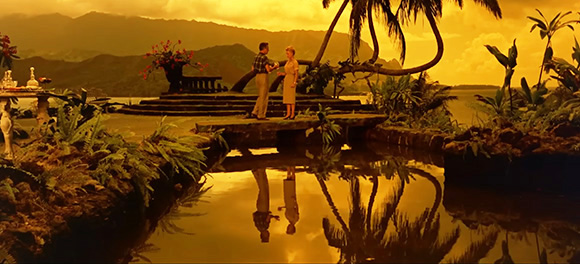 magical cinema - a golden hour in the middle of the day,
and on the verge of "Some enchanted evening"
a still from the movie, South Pacific (1958)
Well, not to the geographical South Pacific, but I had visited the musical in a blog in the noughties, in which I recounted watching the movie after a gap of over 40 years since first seeing it with my father.
I remember very clearly being taken to see the movie at the plushly theatrical Roxy Picture House, just a short walk from our house in Leicester. I can remember being bowled over by the scale and colour, the fabulous songs, and the incredible exotic (I suppose 'foreign' would have been the word then) scenery - but not the length of the movie (3 hours overall), nor that it had an intermission. I can clearly remember the length and the intermission in Lawrence of Arabia (1962). OK this was 3 or 4 years later, was epic, long, had lots of sand, camels, blown-up trains, sword-wielding Arabs, and Peter O'Toole giving the Turks what for (and missed the significance of what one Turkish officer tried to give him) - and while it did have a huge and haunting orchestral soundtrack, it didn't have any songs...
The 1958 movie version of South Pacific was very much of its time, such that frequent use of screen mood-enhancing colour filters did not seem anything other than the magic of cinema for most audiences. The same could be said for the story, as it is simply a story, not just another America-wins-the-Pacific-War movie. It was set in the Solomon Islands in 1943: A French planter, Emile de Becque (played by an Italian), has the hots ("Some Enchanted Evening") for a rather naive ("I could say life is just a bowl of Jello") US Navy nurse from Little Rock. Arkensas, Having a hometown of Little Rock provides a less romantic context for Nellie's story as one year prior to its release saw the Little Rock Crisis. Nine African American students enrolled in a racially segregated high school were subject to verbal and pysical abuse by both white school students and white members of public, and were prevented from attending by the State Governor for "fear of causing riots". It was only after Federal intervention in the form of the National Guard, that the nine students were able to attend the school, though they were still subject to abuse and physical attack. And while footage was already in the can for the moivie before these events, the full significance of the Little Rock Crisis seems not have been appreciated by the Studio at the time, as the movie had other issues with racial stereotyping. called Nellie Forbush (played by Mitzi Gaynor, who changed her name from Francesca Marlene de Czanyi von Gerber). Nellie falls for the Gallic charms of this “Wonderful Guy”, but gives him the cold shoulder when she discovers he has two children whose skin colour is clearly not French ("I’m Gonna Wash That Man Right Outa My Hair". However, the local USMC wants her to persuade de Becque to work as a scout on a nearby island occupied by the Japanese (sounds like a holiday, eh?). He is to be accompanied by the ‘dashing’ Lt Joseph Cable, who has fallen for a (“Younger Than Springtime”) Polynesian girl, Liat, (born in Marseille), but is worried by her ‘strange shaped eyes”! Cable also has a number of secret admirers in the beach laundry who would each love to give him something to remember. Liat’s “mother” is the barrel-shaped Polynesian (born in New Jersey) Mama-san, Bloody Mary, who lures Cable off to the pleasures of Bali-Ha’i ("Someday you'll see me floatin' in the sunshine") and some “Happy Talk” in a magic stream with her underage daughter. Well, to cut a 3 hour musical short, Emile gets his Forbush and Joseph doesn’t return from scout duty... But while all the serious stuff is going on, the comedy is provided by glistenly homoerotic, cross-dressing, massively unemployed marines who fail to convince anybody that they aren’t really very happy with each other as it is, thank you very much, with songs like “There Ain’t Nothing Like A Dame”, and who collectively run a laundry on the beach, and really are the ones who are "as corny as Kansas in August"...
The movie was released in UK on 21st April 1958 (Dominium Theatre, London, running until 1962); 28th April (Manchester); later across the rest of UK. I cannot imagine how my father felt watching this movie in 1958 (even later in 1959), given what happened to my mother that year.