"In heaven. all the interesting people are missing."
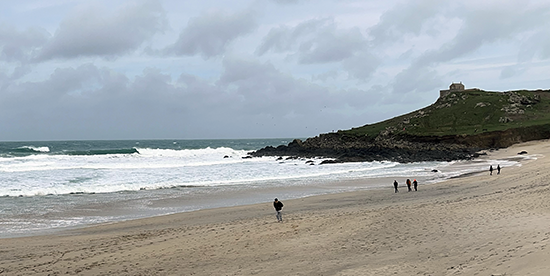
a breezy day at Porthmeor Beach, January 2023
(photograph by Adrian Bregazzi)
'the interesting', and the problem of not being 'interesting'
This text is based on a conversation between the artist, Sesselja Meyer, and Adrian Bregazzi on Porthmeor Beach, and at Tate St Ives in Cornwall in December 2022. This is not a verbatim script of the conversation, rather it is a trimmed down, 'gisted' exchange and development of ideas between two people. It is possible that the text itself may morph into a short film and an accompanying book. Here you can find information about Sesselja Meyer.
[They met at St Erth Station, and took the short train journey along the coast to St Ives. Having swiftly negotiated the town's pre-Christmas bustle, they arrive at Porthmeor Beach where there is just a handful of people strolling on the sand. The neap tide is ebbing slowly; the sky is drawing attention to itself, with rain in the offing; there's a light south-westerly breeze; with temperatures around 11C. ]
Sesselja Meyer:
I was really shocked when you told me that 'interesting' seems to be an implicit element of assessment on your course. It just seems so wrong for an English university to have such overtly subjective criteria. That's why I suggested we meet up and talk about it. And to see how things are going in general for you as a rather elderly student.
Adrian Bregazzi:
I was shocked too, but not surprised to be shocked, if that's not a contradiction. The course structure's preference for box-ticking should have been a giveaway for me, coming from a fine art background where there are no rules as such. No, that's unfair of me - I suppose that all courses will have stages where a box will need to be ticked to allow onward progression, even, I expect, an MA in Fine Art. But there was just an ambiance of persnicketiness from the outset in September. A palpable "just take note!"
And I had also been given advice - a soft warning perhaps - before the course started, about how to behave. Do not create waves! Do not become talked about!
Sesselja Meyer:
What do you mean, you were given a warning?
Adrian Bregazzi:
Well, it was not really a blatant warning - it's a long story - no, it's not really. As you know, I have a long background in photography, and I used to teach photography at degree-level. So there were misgivings on the part of staff about teaching a teacher, if you get my drift. And worries that I may be disruptive. Maybe worries about my background in fine art. The disruptive fine art of the 70s. Prescient worries, as it happens, about the worries that I'm actually having now.
I don't think that even I would have let me onto this course.
But this is a tad off-topic.
Sesselja Meyer:
Quite so. So when did you first encounter the 'interesting' issue?
Adrian Bregazzi:
It came up in a webinar - I hate that word, really, what is wrong with 'seminar'? Whatever, it was suggested that my work, the photographs, that is, were 'abstract', that they needed to be 'interesting'. In other words, they were not interesting for the tutor who led the discussion.
I think I was so taken aback by this that all I could muster, without being disruptive and telling the tutor that they were not actually looking at the work, that the work was not just the images, that text and layout had just as much importance; that I missed the awful significance not just of the requirement for images to be 'interesting' as such, but that the 'abstract' was also not acceptable. Thinking what 'abstract' could be taken to mean in the 'serious' world of photography, actively questions this prescription.
'The interesting' is itself 'abstract'.
Astonishing, really. Not just the matters of the 'interesting' and the 'abstract', but that I had succumbed to a heavy pall of submission. Even to what I now see as submitting to blatant nonsense.
Sesselja Meyer:
And you are stymied, as any meaningful response to this will probably be seen as disruptive.
Adrian Bregazzi:
Exactly. Between a rock and a hard place.
Though possibly not - I am beginning to be tempted to look into making work about 'the interesting'. To Hell with consequences? Some creative, subversive disruption, maybe. Though this would be more effective in a physical art college environment where there is a ready audience, there are opportunities for the impromptu, and it would be relatively easy to fly-post material.
Sesselja Meyer:
But what do you think that they actually mean? What constitutes 'abstract' and 'intersting' in their eyes and minds?
Adrian Bregazzi:
I have wondered that myself. And in terms of 'interesting' I can only come up with words such as 'iconic', 'graphic', 'arresting', 'clever', 'innovative', 'alluring'. But it could also just mean 'visually sexy', and simply 'likeable' in superficial social media terms. Yes, a blue thumbs up. It's down at that level, at least in some cases.
And received wisdom also determines 'the interesting', and the history of photography has a lot to answer for.
Sesselja Meyer:
But surely these perceived qualities can be just as subjective as 'interesting'?
Adrian Bregazzi:
Indeed.
I think that one could look at a person's work to begin to find out what they consider "interesting' - this, whatever it may mean, should surely be a property of their work. And in this tutor's case, there is much opportunity to wonder what kind of person they actually are. In a recently published book, ostensively addressing life during Lockdown, they feature a number of images of their young daughters, scantily-dressed and reclining on a sofa. I wonder whether they are oblivious to perversely slotting children into the art historical trope of reclining women, paying homage to Sally Mann's fleshier family photos, or just seeming to be an appalling parent.
Sesselja Meyer:
This is dreadful. If I was who I used to be I would personally sort this low-life out. I would leave him with something to remind him of his depravity.
Adrian Bregazzi:
Oh. Yes. Best left alone for now, though I do wonder what the university authorities would think of these such images.
But, selfishly returning to me, in this instance, in this critique of my photographs as opposed to my work, there is the context of the mono-discipline of photography and the historic tensions this causes.
[He searches for something on his phone]
I'm tempted to paraphrase one of Sol LeWitt's 1969 Sentences on Conceptual Art. I was re-reading them a few days ago, and after all, I am of that era: "When a word such as photography is used, it connotes a whole tradition and implies a consequent acceptance of this tradition, thus placing limitations on the artist who would be reluctant to make work that goes beyond those limitations."
And on top of this, something that LeWitt probably couldn't have envisaged in 1969, there is the all important virtuality of every piece of work submitted on the course, as unlike the tutor's book-bound images of their scantily-dressed daughters, none has any effectively physical form from first presentation to the point of assessment. Not only is all work in digital form, but visual work can only be viewed by means of a screen. And screens vary a lot.
This is an inherent property of an online course. It's only when you sit back and fully consider the implications of this for the physicality of one's work that it becomes significant. Work will be devoid of heft, haptic, surface, scale, and books their binding; smell and fine detail will be absent. Reduced to a common form. Then, this is how most images are consumed today. The physical is privileged!
Running this model, and more significantly, work on this course does not need to have had any physical form. Conceptually, this surely puts an impossible strain on applying traditional values in assessment.
I may be tempted to look into the possibilities of virtual work - work that in itself does not entail nor require any physical form nor physical action. If that is at all possible.
Back in the day when I was teaching on a fine art undergraduate course, at asessessment times we would be faced with a huge range of media and concerns - from what you may call "craft-oriented" work in printmaking, sculpture, and painting; through to film, live performance, and photographic work. Assessment did not consider whether one found student work 'interesting' nor whether one 'liked' the work. It was all about what the student was actually doing, achieving in their work. OK, 'achieving' is complex here - think 'intention'.
This course is, after all, an MA in Photography, full-stop. It is not a broader MA in something like, say, Lens-Based Media, which nominatively would be inclusive of a wide variety of media and approaches to thinking and making - a domain that would foster not just the moving image, installation, performance, bookwork, and environmental work, but also photographs. Ironically, the course claims to have some of thsi depth, albit ring-fenced by screen delivery.
And in many respects, this critique of photography - the unseen physical photograph - is hampered both by extant C19th ideologies, and the curious need for it, they, the photographs, to be art. For example, the course does not refer to one's work. No, it refers to one's 'practice'. A fairly obvious indicator of retro-aspiration. And this is tantamount to the popular North American transubstantiation of photographs into art, merely by their being printed on 'fine art paper'. Faith gone mad. But I am wandering off-topic again, then maybe I am not. Is this the core of the problem?
Maybe the inability or reluctance of this tutor to try to accommodate, even to understand my work on a superficial level, is based on my work not being about the photograph, not being the photograph. And this potentially insurmountable issue that I am facing is embodied in the course being 'all about the photographs'. This was another webinar bombshell.
Sesselja Meyer:
I want to drag you back to the 'interesting'. I think that you may be wandering off into soapboxing - is that what you call it in English?
Where is 'the interesting' in all this?
Adrian Bregazzi:
Soapboxing... Yes, I was having a bit of a rant. Sorry. Keep interrupting me when I stray!
'Interesting' is the state of having gleaned attention - how does this happen, what properties/qualities are essential for this to happen/cause this to happen in an individual?
I am confident that there is no other way of describing 'the interesting' other than, semantically, if something is 'interesting' for a person, this is entirely subjective to that person. Another person may find that same something 'interesting', but the nature of their 'interesting', as with their 'experience', is entirely subjective to them. We are both here on Porthmeor Beach. We can both see, hear, and smell the same physical sea. But our experience of the moment, however similar that may be, is unique to our individual selves. Yes? The tutor's reaction, assessment, experience, whatever one wishes to call it, and for whatever reasons, realised a lack of his 'interesting' in my work. This has nothing to do with the role of a tutor as it is unlikely, impossible even, for them to be 'interested in', to like, every image presented to them on the course. No, the absence of 'the interesting' here suggests a damping-down of critical faculties. There is no actual engagement with the work itself - the tutor seemed not be bothered to look beyond his personal prejudices and his 'reading' the photographs. Yes, this may have been deliberately, benignly confrontational, intended to make me react, to put me on the 'right track'. The right track in his eyes, that is. But there was no evidence of such a tactic with any other student. Indeed, fellow students did tell me they felt he had been giving me an unnecessarilly hard time in that webinar.
Sesselja Meyer:
So, are you saying that 'the interesting' is an experiential phenomenon? I am not sure that phenomenon is the right word - I am struggling a bit here. It seems real, but it is also elusive. Like Augustine's 'time'. I hate to say it, but one could say that it, 'the interesting' itself, is 'interesting', at least in terms of our conversation. But then we spiral down the proverbial rabbit hole?
Adrian Bregazzi:
Well... it's personal, ideological, political. And yes, very elusive.
But thinking back to what was later said. The tutor's suggestions for taking the work forward. Maybe there's something in there that I have been ignoring. Something that introduces or identifies his 'interesting'.
Sesselja Meyer:
Explain...
Adrian Bregazzi:
Hmmm. I'm certain that you'll not like this. His 'suggestion' was that I make photographs of your early work, and your current work...
Sesselja Meyer:
What the fuck!
Adrian Bregazzi:
What the fuck, indeed!
I had very clearly explained to all that your early work was temporary. fugitive, done. That it was about the making, not so much the made. I had not mentioned anything of your current work.
Naive as this is, this was how I was to make the work, my work, 'interesting'. And it was at this point that he wanted me to show him, and the students in the seminar, a larger version of one of your own monochrome photographs that he said I had included in my presentation about "Sites of Incantation".
Sesselja Meyer:
What?
Adrian Bregazzi:
What, indeed!
You've seen both images before - they were in the pdf I sent sent you. Wait, let me see if I can find them.
[After a search, he finds the images on his phone, handing this to Sesselja.
She enlarges and
briefly studies each image, nodding familiarity with them.]
Adrian Bregazzi:
The first image in the presentation was one that I had taken at Tate Modern in 2014. Metallic paint had been spilled on the polished concrete floor. It looked as if somebody had made a half-hearted attempt to remove it, such that it now appeared to be cloud of silver paint escaping from a roped-off exhibit. I don't remember any other people taking any notice of it. The allusion here to your incantation work was clear to me, but lost on this tutor. And this was clearly captioned as my photograph.
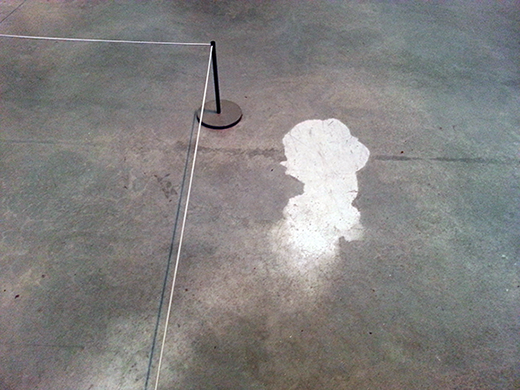
a silver cloud of paint escaping the confines of an exhibit
Tate Modern, March 2014
(photograph by Adrian Bregazzi)
More to the point, this image was paired with a quote from Nadine Dijkstra.
[He checks his phone for the quote.]
Here: "As it turns out, reality and imagination are completely intermixed in our brain, which means that the separation between our inner world and the outside world is not as clear as we might like to think. If our imagination is vivid enough, we will think it is real and we use our imagination to create our perception of reality, which means, [as Hume told us,] 'We do not see things as they are, we see them as we are.'”
Our unique experience again.
But enough of that. The second image was of snow and ice, taken by a lake on a mountain high above Bergen, Norway, also in 2014. The simple visual allusion in context here was to a 'northerly place'; this too was lost on this tutor. And this too was clearly captioned as my photograph.
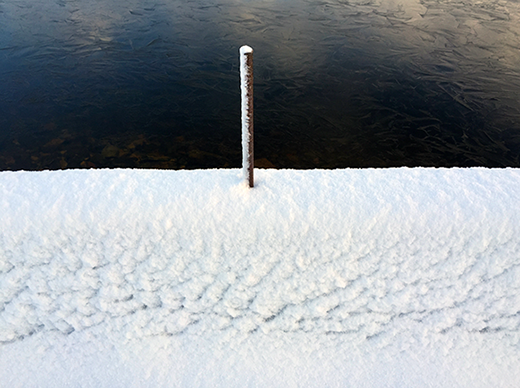
at Store Tindevatnet, a lake on a mountain above Bergen, Norway
December 2014
(photograph by Adrian Bregazzi)
I hope that this doesn't flag that I would need to subtitle each photograph I include in my course work with, "this means...", or tooltips for dummies... There should be a baseline of visual literacy at this level, surely?
And yes, the colour in both photographs is subtle. But it should be obvious that they are not monochrome, unless a viewer's colour vision is challenged, or that they did not look too closely, or that they are using a device with a poor screen, or in a room with bright lighting, sunshine. Why am I giving them all these excuses?
I had no idea what he meant by referencing your monochrome photographs, and his tone became rather fractious and condescending when I couldn't deliver on his demands. I had no idea what he was asking for. It wasn't a good moment. I'd had enough of it. And this was picked up by other students.
Sesselja Meyer:
I can see no reason for these images to be regarded as my work - given that I do not actually make physical work as far as this is concerned. And especially as you have made this clear in your description of how you have developed your own working methods in "Sites of Incantation". This does suggest that criticism is being developed without assembling even the basic facts about the work. Sad, really - this is supposed to be a postgraduate course.
Adrian Bregazzi:
I have since been led to believe that the tutors may be using laptops with just 13" screens. This should not normally be an issue, but you can imagine that looking at hundreds of students' photographs may be tedious if you have to zoom in on images. I am not saying this to excuse the tutor's errors as these may have been exacerbated by inadequate facilitation. They really should have been checked.
Sesselja Meyer:
But why pick those two images? Just because he thought they were black-and-white?
Adrian Bregazzi:
I am not sure. Maybe they were easy pickings right at the beginning of the presentation. Maybe because they are outside the work - damn Derrida! Yes, maybe because he saw them as black-and-white, with all the other images as clearly being in colour. A positive decision on my part to separate these two images? Who knows?
There again, it may simply be that in his view these two images 'are interesting' - that they may actually passed his attention test. They are both graphic - hence they may fall into the category of 'easy', and not requiring any onerous thinking on the part of the viewer.
And I'm sure that he wouldn't have looked at the Tate image long enough to see its magic - how the paint 'behaves'.
Sesselja Meyer:
So, to be clear - are we anywhere near to identifying the elements of 'the interesting'?
[It has begun to rain.]
Rain check, let's head for the Tate!
[They hurry to the nearby Tate Gallery.]
Sesselja Meyer:
OK, back to business. So, 'easy' seems to be the core nature of 'the interesting'? Or is that too damning? Is it just about attention, the same as standing out from the maelstrom of social media image glut? This is borne out by your once telling me about the photographs in "Sites of Incantation" - that they are intended to be quiet, static, locative. Hence, they are of no 'interest' in the doomed world of the gratuitous instantaneous?
I'm getting a bit carried away here. Struck down by melodrama and Cornish rain.
[They have now found a table to themselves in the top-floor Tate Cafe.]
So, if instantaneity is the core of 'the interesting', and this seems quite feasible, then it says very little of the effective critical faculties of the viewer. Barthes' punctum raised to a high point of superficial mediocrity. His 'prick', so to speak.
Listen to me, I only have to enter an art gallery to start spurting smutty artspeak!
Adrian Bregazzi:
Prick, indeed!
I am contented that my photographs in "Sites of Incantation" can be described as all studium and no prick. That is the point - sorry - of them. I have maintained all along that that work is not all about the photographs, rather it is about the image and the text, and the interaction of the image and the text, and what comes from that interaction. The photographs are not there for titillation. As you know, they are intended to work as forensic documents for siting an incantation. And my whole experience of their making on location is essential to the work.
Sesselja Meyer:
Then we should look at where this 'interesting' sits on the studium >< punctum spectrum? Will it always be on or at the punctum end?
Adrian Bregazzi:
I suspect it'll always be at the punctum end if we are using Barthes' terminology. But it may be simpler. clearer, to look into contexts and functions. And move away from a generalised Barthes' world.
There seems to be a fundamental lack of understanding on the course of the difference between image/text and photo/caption. This may appear semantic, and it would probably be seen so even by most of the people looking at art, or sitting around us here in the learned environment of The Tate.
But, pick up any monograph from the bookshop here and it will feature images with a contiguous identifying text. Figures and captions in academic terms. The function of the caption text is passive qualification of the image with, say, artist, artist dates, title of work, work date, medium, size, locator, etc.. The caption text is simply a list of the illustrated work's properties. It does not actively engage with the image. Yes?
A piece of work that includes image and text, where text is an active element within the work, is quite different from the figure/caption combination. Here - image-text - the text is an essential, symbiotic part of the work. The work is not the work without the text. This is not the case with the captioned image.
Image-text has been part of mainstream Western art for at least 50 years. Far longer if you include Duchamp's L.H.O.O.Q. It's sad that it seems not yet to have arrived on the course. I wonder if this has anything to do with the tutors' own creative visual work - those who actually make work, that is.
Unfortunately, my work is seen by the course, at least in open discussions, in terms of figure/caption. It has been clearly stated that the text being on a separate page from the image makes it too difficult to view the work. This is figure/caption mentality. And maybe this goes all the way back to one of my first comments today about box-ticking persnicketiness. Whatever the case, this is a root-level problem. Physical and conceptual, embodied in, and sadly epitomised by "it's all about the photographs" - nothing else counts.
Of course, there are canonical exceptions to this, the most obvious being found in the work of Martha Rosler. Or should I say, "Martha Rosler's practice", as she has been accepted into the photography fold. With Sophie Calle a close second. Their various work sits at different locations within the image/text >< figure/caption spectrum. But I think that this is another discussion.
Sesselja Meyer:
OK. So how will you deal with these problems?
Can you really continue on a course that does not seem open to your ideas and ways of working, without your being somehow disruptive? Is it worth the energy? Would it be worth the fees? Is it worth the disappointment? You could easily spend that money and time on developing your work without the hassle of the seemingly limited aesthetics of the course.
I cannot see you making work - discrete photographs, that is - just to fit in with something you cannot subscribe to. In fact, I would do all I could to stop you doing that!
Adrian Bregazzi:
Thank you!
Indeed. A bit of a quandary.
There's no disputing that my own work has not got value for money from the course so far. And I am minded that there's no firm evidence of enough potential in the immediate offing to warrant continued attendance on the course. Having said that, there is a multidisciplinary study block scheduled for the summer that looks really challenging - the tutor is based in Japan, and doesn't only make photographs.
And I have asked about intermitting. But I know from my own experience that only about 10% of students actually re-join a course after a period of intermittance. So intermittance just seems to be about delaying withdrawing from a course. Why not quit now?
The next study block doesn't start until some time towards the end of January. So I have a few weeks to mull over the options. As a rather elderly student, that is.
Sesselja Meyer:
Successful mulling then!
I am happy to chat about work whenever you wish. Just let me know. Newlyn next, maybe?
OK, there is a painting downstairs in the Gallery I would like you to see. I think that you will find the artist and her work interesting - sorry!
I have great respect and fondness for her painting and her writing. She was also an immigrant - from Iran, and in her case she came to the westerly elsewhere that was England, and finally, to West Cornwall.
[as they walk down to the Gallery itself...]
Adrian Bregazzi:
Oh, apparently I am also not passionate about my work - "passion" being another criterion of
assessment. But I think it's best left hanging there...
so ending this long conversation with a heavenly quote to hold hands with the opening Nietzsche attribution:
"Heaven
Heaven is a place
A place where nothing
Nothing ever happens"
Meanwhile, I recently found this almost forgotten image made during a voyage from Bergen along the west coast of Norway and through the Barents Sea to Kirkenes, on the border with Russia. It is a photograph, a singular photograph, albeit from the ship's bow video camera. Rather, it's a still from a video I recorded of the ship's bow camera live stream in the middle of the night. However, as it is actually captioned rather than accompanied by some pesky text, could it fufil the course definition to be deemed 'interesting'? Or maybe it's not a real photograph.
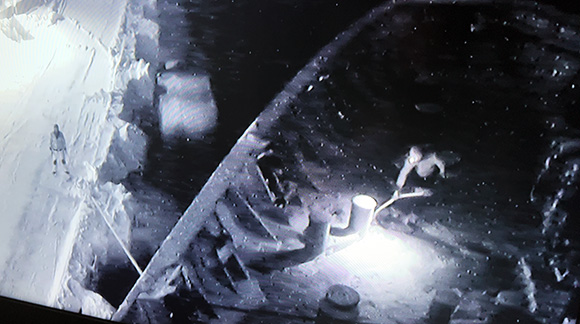
about to depart Brønnøysund for Alsta and Nesna, 01:37, 8th February 2024
a video still taken from MS Nordlys' bow camera live stream