This is a very rough shooting script ofr a film, to the painting, which I worked on in the second study block of the MA (January 2023).
to the painting
This is a very rough, initial script for a piece of work loosely based around Sesselja Meyer's wandering thoughts while on a train journey between St Erth and St Ives (in Cornwall), to see a painting in Tate St Ives. This script is changing daily.
- need to accommodate ticket checking - leave in or cut out? not an issue if it's a second run
- miss out large section around Carbis Bay - use trees/shrubs to cut from one view to another
- need static shots of estuary birds - moving and/or still? not needed
- how to get long-shot of lighthouse - moving and/or still? not needed
- getting from St Ives station to the Tate not needed
- the getting into the Tate
- the sequencing in the Tate first image is of Tacita's sinking ship
- mention of the car on the track - "was that the bridge?" - on the other side of the train? not needed
and voices needed
- the 'main' voice - female, 40ish, ideally with a nordic accent
- voice for the gallery wall text - English, male?
- voice for Zia quotations - Hosna Navabi
- voice for The Goldfinch quote - American/Canadian? if I can persuade them?
The words of the primary voice are those of
Sesselja Meyer.
total voice time: 437 seconds (30th January)
link to HD video of the view from the train window (11 minutes) (see)
| ID | time | image | sound |
|---|---|---|---|
| text | text | (starts) | there will be edited sounds from inside the train audible throughout the train journey - these will provide a continuum |
| text | text | (title: to the painting) | |
| text | text | 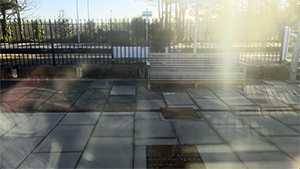 nothing happening at St Erth Station |
(train announcement - must not include Carbis Bay) |
| text | [50 sec] | train has started moving slowly |
[a Nordic female voice] (she sighs) "I wonder, leaving as quickly as I could, quicker even, not drawing attention, not on a train, less obviously, as my life depended on it; or leaving as slowly as possible, preferably not at all, where love is involved." "We'd been talking of a short vacation in Sicily when my train was called. 'I hate goodbyes at stations, too Brief Encounter: tears, you know.' she said. A hug, her kiss, a big smile, 'safe travels! text me!' and she disappeared back into the Underground. I've never seen her since. Worse, I suppose, impossible maybe, would be the combination - of leaving both fear and love..." |
| text | [17 sec] |  |
[a Nordic female voice] "But leaving, departing, will also always mean going to somewhere else; and still you may not be able to get there quickly enough, or you may hope you'll never arrive, even though there's nowhere else for you to be. Oh, this is all rather existential!" |
| text | [24 sec] | |
[a Nordic female voice] "Most journeys are not extreme, they are run-of-the-mill, of no consequence in themselves, just part of a daily grind even, instantly forgettable, you even switch-off. And there are journeys for journey's sake and the simple joy of the getting somewhere else; and there are journeys like this, with a benign purpose. To see something of beauty and loss." |
| text | [45 sec] | 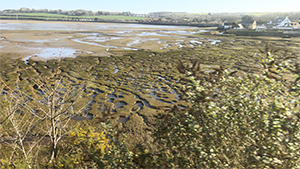 slowed down or still image |
[a Nordic female voice] "or is it all make-believe, as it often was when I was a child? I always seemed to want to be somewhere else - away from all the stuff. I loved trains, hated coaches, we had no car, I could not ride a bike. But I could think myself into other places - often in church; before falling asleep; when I'd nothing to do. I was told off a lot for daydreaming. Where I've just been, I still am. We had winters back then, there. They'd last for months, we just got on with life, and we loved the fireside, and toasting buns, warm thick pyjamas, candlelight, bedtime stories. All gone. There are no winters here." |
| text | text | some text | some text |
| text | [32 sec] |
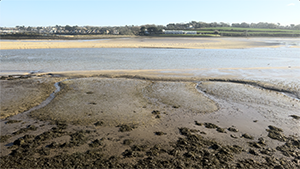 possible cut to static shot of estuary birds? |
[a Nordic female voice] "The estuary - an odd word - Latin, I suppose. Saltings and mud flats, twice-daily inundation; severely unappealing to humans; but havens and food and safety for myriad birds." "Black-backed thugs, raucous sky-rats, and quarrelsome black-heads. A fluttering and soft piping from hazy flocks of small waders. With twitchy egrets, brilliant white and black, stalking the peripheries. Scavenging crows. Static herons. Birders with binoculars." |
| text | [49 sec] |
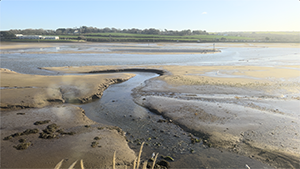 possible cut to static shot of eatuary birds? |
[a Nordic female voice] "Some of these birds are sedentary, charmingly, homely even, dubbed 'residents', living out their entire avian lives here by Hayle. Others spend our winter here, to return to the arctic for its short summer, while others appear in autumn and spring, on passage from and to their own winters and summers - the estuary is R and R and frantic stocking up on food for them; year after year of unencumbered avian leaving and arriving, going to and coming from - no tickets, passports, travel angst, nor luggage; no looking over their shoulders for unwanted followers, no fear of shadows, nor being stopped. Nor looking back for a last fading glimpse, longing, lost." |
| text | [20 sec] | toasting buns? |
[a Nordic female voice] "I can never go back. I have no desire to. I am not haunted by the leaving. There is no loss. I can toast buns. I have candles. I have underfloor heating. I can tell stories to Elgar. I am where I want to be. For now. I deal with the now. Always with the now. My own now..." |
| text | [45 sec] |
this sequence should come earlier passing stuff - maybe repeated at "mesmerised"? |
[a Nordic female voice] (sighs) "'too Brief Encounter' - but don't we all become Laura when, unwittingly turning-off, daydreaming, idly staring out of a moving train's window, we may become mesmerised by the flickering trees and bushes and posts and railway whatnot; then, without our really thinking about it, we have become stationary, and it is our fluttering thoughts and memories and imaginations and fears and longings that rush in and out of view. And then, like Laura, when something imperceptible nudges us, we are wingless again, shocked, back in a moving train, returned to the clatter of the real world, wondering how long we'd been away, and hoping nobody noticed." |
| text | text | 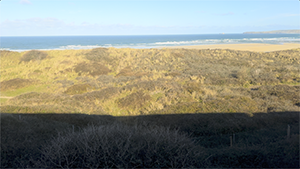 |
(the estuary grows into St Ives Bay) |
| text | [35 sec] | 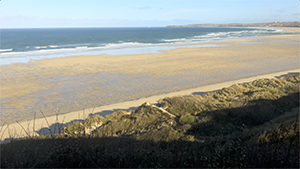 with long-shot of Godrevy lighthouse? |
[a Nordic female voice] "I cannot unthink, 'Virginia Woolf', when that lighthouse first appears from wherever I've been. It's not the one in the novel, but it's probably the one that formed the model, from all the weathers of her childhood times in St Ives. And Kristeva on Woolf, 'estranged from language, women are visionaries, dancers who suffer as they speak' - extraordinary vision. Where on earth did that come from? Zia had another lighthouse in mind, further to the south-west, on Wolf Rock, 'at a distance almost reachable with one eye shut.'" |
| text | text |
ives_300.png) missing out section around the Carbis Bay stop here |
no text |
| text | text |
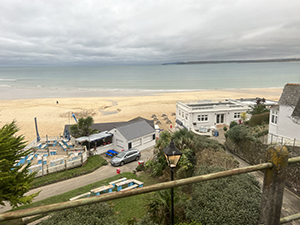 arriving at St Ives (this is Porthminster) |
(train announcement of arrival at St Ives station) |
| text | text | 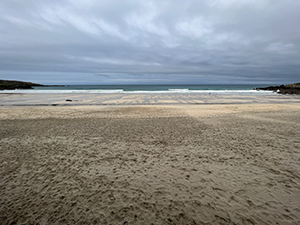 Porthmeor Beach |
no text |
| text | text | 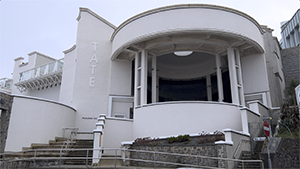 arriving at Tate |
no text |
| text | text |
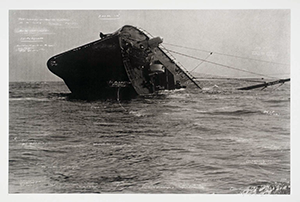 at Tate - one of Tacita's shipwreck postcards sounds of the gallery continue to next shot |
no text |
| text | [41 sec] |
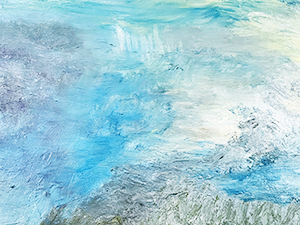 or an image of calm sea, preferably turquoise... |
[an 'English' male] (reading of this text from her husband, Richard Cook's introduction
in Alchemy) "Partou Zia was deeply affected throughout her life by her state of exile from her beloved Iran: 'the magical reality I had left behind on that hot June morning, when I walked across the melting tarmac, up the uncertain steps to the entrance of the enormous jet plane' - a land always out of reach. Moving to Cornwall gave Zia the light of the Caspian Sea, and walking on Dartmoor the mountains of her lost Persian landscape. She described her life in Cornwall thus: 'Blue sea and stillness; I love this light of soft turquoise restful in its sense of infinity.'" alternative text (too long?) (the text on the wall that accompanies the painting) "Partou Zia’s visionary paintings combine the myths and memories of her childhood in Iran with the later quietness of her everyday life in Cornwall. In painting, Zia explored how colour could transcend moments of both real and remembered experiences. Her works combine traces of the real world, suffused with the heightened light and spectrum of colours found in memory and imagination. The daughter of a communist activist, Zia arrived in London from Tehran in 1970 as a political refugee. This imposed displacement was a potent force in her work. Zia’s canvases embody her search for the personal spirituality she was denied in her early years due to her political upbringing." |
| text | [25 sec] | 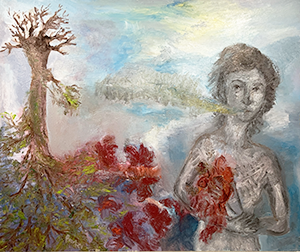 |
[an Iranian female voice] (The text is from The Notebooks of Eurydice, in Alchemy) "In dreams, meetings of unlikely souls are taken for granted, and yet we lead such prescribed circles of existence when awake. Living a story at every given moment, my mind is full of conversations, predictions or memories of other stories, the entire edifice jostling for a place in amongst the many other things seen, remembered or overheard." |
| text | [17 sec] | |
[an Iranian female voice] (The text is from The Notebooks of Eurydice, in Alchemy) "Everything arrayed across my eye's vista as if a memory or a recalling of a hazy memory, or perhaps a snippet from a nameless movie; this reality or factual thing can only be a delicious fiction in which I am to play the protagonist." |
| text | [15 sec] |
or another close-up of the painting? |
[a Nordic female voice] "A beautiful painting. Good times maybe. But another caption tells us the artist died young. She is gone in body; she remains here in a painting. Lost, but secure. What is going on in this painting?" |
| text | [22 sec] | or words on screen? |
[a North American female voice] (Text is the last sentence of Donna Tartt's, The Goldfinch) "And as I add my own love to the history of people who have loved beautiful things, and looked out for them, and pulled them from the fire, and sought them when they were lost, and tried to preserve them and save them while passing them along literally from hand to hand, singing out brilliantly from the wreck of time to the next generation of lovers, and the next." |
| text | text |
Partou Zia born, Tehran, 9th October 1958 died, Cornwall, 19th March 2008 |
|
| text | text | (credits) | |
| text | text | (ends) |
This a first attempt at getting a sense of timing, and how lines and images may work
together, fit together, spaces. And how long the piece needs to be to include the current
script.
| ID | time in | time out | image | script |
|---|---|---|---|---|
| 1 | 00 | 15 | St Erth station platform | (train announcements) |
| 2 | 16 | 66 | train leaving St Erth |
[50 secs] [a Nordic female voice] (she sighs) "I wonder, leaving as quickly as I could, quicker even, not drawing attention, not on a train, less obviously, as my life depended on it; or leaving as slowly as possible, preferably not at all, where love is involved." "We'd been talking of a short vacation in Sicily when my train was called. 'I hate goodbyes at stations, too Brief Encounter: tears, you know.' she said. A hug, her kiss, a big smile, 'safe travels! text me!' and she disappeared back into the Underground. I've never seen her since. Worse, I suppose, impossible maybe, would be the combination - of leaving both fear and love..." |
| x | ||||
| x |
[17 secs] [a Nordic female voice] "But leaving, departing, will also always mean going to somewhere else; and still you may not be able to get there quickly enough, or you may hope you'll never arrive, even though there's nowhere else for you to be. Oh, this is all rather existential!" |
|||
| x | ||||
| x |
[24 secs] [a Nordic female voice] "Most journeys are not extreme, they are run-of-the-mill, of no consequence in themselves, just part of a daily grind even, instantly forgetable, you even switch-off. And there are journeys for journey's sake and the simple joy of the getting somehwere else; and there are journeys like this, with a benign purpose. To see something of beauty and loss." |
|||
| x | ||||
| x |
[45 secs] [a Nordic female voice] "or is it all make-believe, as it often was when I was a child? I always seemed to want to be somewhere else - away from all the stuff. I loved trains, hated coaches, we had no car, I could not ride a bike. But I could think myself into other places - often in church; before falling asleep; when I'd nothing to do. I was told off a lot for daydreaming. Where I've just been, I still am. We had winters back then, there. They'd last for months, we just got on with life, and we loved the fireside, and toasting buns, warm thick pajamas, candle light, bedtime stories. All gone. There are no winters here." |
|||
| x | ||||
| x |
[32 secs] [a Nordic female voice] "The estuary - an odd word - Latin, I suppose. Saltings and mud flats, twice-daily inundation; severely unappealing to humans; but havens and food and safety for myriad birds." "Black-backed thugs, raucous sky-rats, and quarrelsome black-heads. A fluttering and soft piping from hazy flocks of small waders. With twitchy egrets, brilliant white and black, stalking the peripheries. Scavenging crows. Static herons. Birders with binoculars." |
|||
| x | ||||
| x |
[50 secs] [a Nordic female voice] "Some of these birds are sedentary, charmingly, homely even, dubbed 'residents', living out their entire avian lives here by Hayle. Others spend our winter here, to return to the arctic for its short summer, while others appear in autumn and spring, on passage from and to their own winters and summers - the estuary is R and R and frantic stocking up on food for them; year after year of unencumbered avian leaving and arriving, going to and coming from - no tickets, passports, travel angst, nor luggage; no looking over their shoulders for unwanted followers, no fear of shadows, nor being stopped. Nor looking back for a last fading glimpse, longing, lost." |
|||
| x | ||||
| x |
[20 secs] [a Nordic female voice] "I can never go back. I have no desire to. I am not haunted by the leaving. There is no loss. I can toast buns. I have candles. I have underfloor heating. I can tell stories to Elgar. I am where I want to be. For now. I deal with the now. Always with the now. My own now..." |
|||
| x | ||||
| x |
[45 secs] [a Nordic female voice] (sighs) "'too Brief Encounter' - but don't we all become Laura when, unwittingly turning-off, daydreaming, idly staring out of a moving train's window, we may become mesmerised by the flickering trees and bushes and posts and railway whatnot; then, without our really thinking about it, we have become stationary, and it is our fluttering thoughts and memories and imaginations and fears and longings that rush in and out of view. And then, like Laura, when something imperceptible nudges us, we are wingless again, shocked, back in a moving train, returned to the clatter of the real world, wondering how long we'd been away, and hoping nobody noticed." |
|||
| x | ||||
| x |
[35 secs] [a Nordic female voice] "I cannot unthink, 'Virginia Woolf', when that lighthouse first appears from wherever I've been. It's not the one in the novel, but it's probably the one that formed the model, from all the weathers of her childhood times in St Ives. And Kristeva on Woolf, 'estranged from language, women are visionaries, dancers who suffer as they speak' - extraordinary vision. Where on earth did that come from? Zia had another lighthouse in mind, further to the south-west, on Wolf Rock, 'at a distance almost reachable with one eye shut.'" |
|||
| x | arriving at Porthmeor Beach | |||
| x | arriving/entering Tate (but note building work!!!) | |||
| x | Tacita's shipwreck image(s) | |||
| x | video of the turquoise/blue part of the Zia painting |
[42 secs] [an 'English' male] (reading of this text from her husband, Richard Cook's introduction in Alchemy) "Partou Zia was deeply affected throughout her life by her state of exile from her beloved Iran: 'the magical reality I had left behind on that hot June morning, when I walked across the melting tarmac, up the uncertain steps to the entrance of the enormous jet plane' - a land always out of reach. Moving to Cornwall gave Zia the light of the Caspian Sea, and walking on Dartmoor the mountains of her lost Persian landscape. She described her life in Cornwall thus: 'Blue sea and stillness; I love this light of soft turquoise restful in its sense of infinity.'" alternative text (too long?) (the text on the wall that accompanies the painting) "Partou Zia’s visionary paintings combine the myths and memories of her childhood in Iran with the later quietness of her everyday life in Cornwall. In painting, Zia explored how colour could transcend moments of both real and remembered experiences. Her works combine traces of the real world, suffused with the heightened light and spectrum of colours found in memory and imagination. The daughter of a communist activist, Zia arrived in London from Tehran in 1970 as a political refugee. This imposed displacement was a potent force in her work. Zia’s canvases embody her search for the personal spirituality she was denied in her early years due to her political upbringing." |
||
| x | ||||
| x | the full painting |
[25 secs] [an Iranian female voice] (The text is from The Notebooks of Eurydice, in Alchemy) "In dreams, meetings of unlikely souls are taken for granted, and yet we lead such prescribed circles of existence when awake. Living a story at every given moment, my mind is full of conversations, predictions or memories of other stories, the entire edifice jostling for a place in amongst the many other things seen, remembered or overheard." |
||
| x | ||||
| x | the full painting |
[17 secs] [an Iranian female voice] (The text is from The Notebooks of Eurydice, in Alchemy) "Everything arrayed across my eye's vista as if a memory or a recalling of a hazy memory, or perhaps a snippet from a nameless movie; this reality or factual thing can only be a delicious fiction in which I am to play the protagonist." |
||
| x | ||||
| x |
[15 secs] [a Nordic female voice] "A beautiful painting. Good times maybe. But another caption tells us the artist died young. She is gone in body; she remains here in a painting. Lost, but secure. What is going on in this painting?" |
|||
| x | ||||
| x |
[22 secs] [a North American female voice - need to keep this separate from the previous Nordic voice] (Text is the last sentence of Donna Tartt's, The Goldfinch) "And as I add my own love to the history of people who have loved beautiful things, and looked out for them, and pulled them from the fire, and sought them when they were lost, and tried to preserve them and save them while passing them along literally from hand to hand, singing out brilliantly from the wreck of time to the next generation of lovers, and the next." |
|||
| x | ||||
| x |
(text on screen) Partou Zia born, Tehran, 9th October 1958 died, Cornwall, 19th March 2008 |
|||
| x | ends | |||
| x | ||||
| x |